Showing posts with label Lacey Gunter. Show all posts

Saturday, September 9, 2017

Finding Your Voice Through Storytelling

By Lacey Gunter

I had the opportunity this weekend to attend the Timpanogus Storytelling Festival for the second year in a row. I went with my parents and my kids and we had a great time.  Some of the stories were unique and personal, some were retelling of an old classic in a new way, and some were just off the wall zany and silly.

I love listening to the stories, but one of the best reasons to come to a storytelling festival is to hear each of the story teller's unique voice.  I don't mean the actual tone of their voice, but rather the way they tell their story.  A storyteller's unique voice is at least half of what draws an audience into their story.  In much the same way, a writer's voice is critical in drawing a reader into their story.

But how do we get our writer's voice or even know what it is?  If you've ever got the feedback on a manuscript that your story lacks voice or needs more of your own unique writer's voice, it may not be obvious how to get it. Fixing grammatical errors, making characters more three dimensional, mending plot holes or spicing up a query letter can be difficult tasks. But there are typical tried and true ways to help you accomplish these tasks and most authors with enough commitment can reasonably manage them.

Knowing how to find your unique writer's voice, on the other hand, may not be as apparent. Finding your unique writer's voice isn't exactly something you can learn from studying writing books or talking to successful authors. So what's a writer to do? My suggestion to you is to try out storytelling. If you can figure out how to draw someone you are talking to into a story, your unique voice is going to naturally shine through in your writing as well. 

Start out small and easy. Pick a story you know really well. It can be a memory from your own life or even a tried and true fable you've heard a thousand times. Then find a small audience, or even a camera or mirror, and give it a whirl.  The more you practice, the better you are going to get and the more you are going to discover what kind of stories your good at telling and how you like to tell them.

Saturday, August 26, 2017

Muse Wanted

By Lacey Gunter

Muse, my muse, I've been a tad busy lately.
Not by choice though, life and responsibilities just got a little ahead of me.
I've come back to you begging on hands and knees to be my friend again.
Whisper those sweet little ideas into my mind, even in the middle of the night.
I won't complain. I promise.

Muse, sweet muse, remember the good old days when we use to be thick as thieves.
You'd introduce me to all sorts of crazy characters.
We'd plot and scheme together.
You always had a way of making me laugh at the most inopportune times.
We were good together, you and me.

Muse, hey muse, I know you love a good game of chase.
I've got my running shoes on, see.
You can start us out with just the mere shadow of an idea, and I can...
Wait, what was that, ... wait, I wasn't quite ready... ouch... slow down ...please!
You know this game is a lot more fun when you let yourself get caught once in a while.

Muse, crazy muse, alright, I can see you've already got plans tonight.
Well, if you change your mind, I'll just be sitting here in front of this computer all night.
And for your information, I won't even think about getting on Facebook.
You do remember my number, don't you?
Well, I guess I'll be seein' ya...hopefully.


Saturday, May 6, 2017

Some Fun Writing Exercises

By Lacey Gunter

Published authors often say if you want a successful writing career you should be writing consistently, perhaps even daily. Sometimes though you get stumped in your current WIP and you don't really know what to write.  I have already discussed ways to try get moving on your WIP again here and here.  Sometimes though, what you really need is just a little break from your manuscript.  when this happens writing exercises are a great way to keep you writing and maybe even generate a few new ideas. Here are a few writing exercises you might want to try next time you need a break, or even just for fun.

1. I call this one Beta Reader Blitz: Have you ever had a beta reader who didn't really 'get' your manuscript and insisted you should change it to sound more like a different genre (like maybe the genre they love writing in). Well just for fun or practice, do just that. Take you current manuscript, or even a much loved book and try and tweak it to fit a different genre and write a synopsis for it or rewrite one of the chapters.

2. This one I call Sensational Reporting: Go to your favorite news website and find a report on a situation or event that is just developing. It's best if you find an article where some important aspect of the story has not yet been discovered or reported on.  Then write a new article filling in those details or explaining the event or situation using you imagination. It can be realistic or completely farcical, just have fun with it.

3.This one is the opposite of a modern remake: Take a modern day story, like something that has happened in real life in the past 5 years, or a story that takes place in modern or future times and try to remake to fit in a different era in history, in particular, a past era.  Write a synopsis for the story or a chapter.

4. This one can be funny or romantic or perhaps even a horror: Take a much loved female character from one story and a popular male character from another story and write about the two going on a date.

Or come up with some writing exercises of your own. Either way, have fun and just keep writing.

Saturday, April 8, 2017

Subbing in the Rain

By Lacey Gunter

Unless you're that strange freak of nature that submits your first manuscript and magically turns it into a sale with the first person you submit it to, you will inevitable have to face rejection and the pain and disappointment that come with it, if you're seeking to get published.

Let's face it, rejection is painful. It hurts a little less when the rejection is personalized and encourages you how and in what direction to go, but even that is still disappointing. I wish I could give you some magic formula for avoiding rejection, but if I knew one I would already be using it myself.

When you know you're getting yourself into a likely painful situation, it's usually wise to take some time to think about how you can minimize or manage the pain. This is important when you are querying or submitting a manuscript because it's easy to get depressed or discouraged and throw in the towel before the fight is over. 

If we think about rejections as rain drops and the ensuing disappointment and pain as getting wet, the goal would be to get through the rain storm as dry as possible. Obviously, we could use an umbrella, but to me the equivalent of that would be to just not sub in the first place, which would get us nowhere. So assuming it is just us and the rain, how do we get the least wet?
There has been much debate about which gets you wetter, walking or running in the rain.  The most detailed research suggests running is better, but what matters more here is that both walking or running are going to be better than just sitting down in one spot and hoping for the rain to stop.

So how does this apply to subbing?  If all you are focusing on is this one manuscript and getting it published, you may be simply sitting down and waiting for the rain to drench you in despair. You may get lucky and the rain storm will be short and the sun will shine on you and dry out your despair. But if you aren't, as most of us are not, the rain may drench you so bad you decide is it not worth the pain and hassle.

The better plan is to get up and get moving; start on a new project, explore some new ideas, immerse yourself in a new story, or even a few. This way you are actively moving toward your goal. You have more than one prospect and a rejection on one doesn't seem quite so devastating.  Your chances of reaching your goals of getting published will improve and you'll have something to distract yourself from the pain of rejection. Plus, maybe you'll find someone else running in the rain and you can just run behind them and let them get most of the drops. 😜

Saturday, March 25, 2017

Summer of Service

By Lacey Gunter

After hearing some lovely and inspiring women speak tonight I was reminded of the value of service in creating a happy life. It inspired me to again strive to do more service in my life.  Not only is this an important consideration for busy moms, but I believe it is critical for our children.

Our kid-centric parenting culture is obsessed with making sure kids are having fun. I feel we do a disservice to our children if we model that this is the only way to experience joy in our lives.  At this time of year when parents are anticipating summer and signing kids up for engaging summer and sports camps, and planning their elaborate vacations to theme parks and playlands, it might be beneficial to stop and think. Amidst all this time and resources we are putting into making sure our kids are brilliant, talented and fun-loving, are we putting in the same amount of consideration on how to help our kids become more thoughtful, generous and loving towards others?

I used to put together a summer play group for my kids and the kids in our neighborhood. I put a lot of time and effort into finding or creating fun and engaging activities for the group. But last year the thought occurred to me that maybe my kids need less awesome play-dates with their friends and more character building experiences helping those experiencing a trial or sacrificing for those less fortunate. So now I try to put together a kid friendly summer service group.

The first time I did it, last summer, I thought I needed to have projects that were big and certain to make a difference in many people's lives, which was a little challenging as I didn't have very many ideas for how a bunch of young kids could do that.  But overtime, I have realized that even small but personal acts of service can make a big difference in both the people you are serving and the children doing the service. Something as simple as drawing pictures and making love or thank you notes for the people in your neighborhood can create a feeling of love and happiness in your neighbors for several weeks or even several months. At the same time, it is a completely manageable task for even a toddler, with just a little parental help, that can spark a joy for service that will lead a child to want to do it again and again.

I am looking forward to doing a summer service group again this year. The projects probably won't be as big and monumental, but I am confident they will still be life changing. 

Saturday, March 11, 2017

Patience is a Virtue

By Lacey Gunter

If there is one thing I could express to help a new writer starting on their journey toward getting published, it would be the value of patience. Despite how little patience exists in this breakneck-paced world we live in, you won't survive the publishing journey without it.

We can never assume our readers will have patience. Many will drop you after a single chapter if you haven't already wooed them into staying. Or maybe just after the title and front cover, if you are a picture book writer like me.  We can't expect agents or editors to have patience. I have heard no small number of them claim they typically dump manuscripts after a single paragraph. Not to mention the worse reality when they refuse to even consider a manuscript due to a less than super sparkly query letter.  And we certainly can't expect a publishing company to have patience. Most of them won't even give your manuscript space in a super long slush pile without the official credentials of an agent, even if that slush pile is only virtual.

But guess what folks; all of those people are expecting a boatload of patience from you.

First of all, you've got to be patient with your manuscript. Finishing the book is just the first small hurdle, because you're not really finished. Next comes chapter/book critiques, which you better be patient in waiting for or your critique partners will pulverize both your ego and spirit into the ground as they rip apart your manuscript. It's worth the patience it takes for them to figure out nice ways to say their piece. Then you have to patiently consider all the helpful and sometimes not so helpful feedback; followed by a lot more patience with yourself as you work toward sincere improvements to your manuscript.

Once you finally get to the point where it seems like your manuscript might actually be ready to start sending out to the world of agents, here comes another big waiting game. First, you wait weeks and months for silence.  Then if you've taken the time to search out agents who actually respond, you can wait weeks and months for form rejections letters. Once you've been patient enough to learn how to write a good query letter and actually get a chapter or book in front of an agent, you get the opportunity to wait weeks and months for personalized rejections, and boy won't your be happy about that. If you've been patient enough to decipher the meaning out of the personalized rejection and taken the time to fix up both your query letter and manuscript one day you might get to experience the joy of landing an agent.

But don't get too excited yet, because most agents still want you to do some pretty significant edits, which you must patiently consider and work on. Then comes the lovely submission dance you just went through all over again, only this time it's your agent doing the dancing while you patiently wait in the background. So fun! Finally you might get a book contract. Woohoo, end of waiting, right? Nope, here comes lots more editing, and lots more waiting, probably two years of it. All of this of course is assuming that manuscript you wrote is good enough to publish. For most people, their first manuscript is not. So then you have to start all over.

It may sound overwhelming and depressing. Sometimes it is. But if you truly possess the patience to see the process through, especially if you have the stamina to do it more than once and learn along the way, you have a much greater chance of success.  Just be patient.

Saturday, January 28, 2017

Audio Book Love, Part 2

By Lacey Gunter

So I already posted about how much I love audio books on this blog a couple years back (Sheesh, have I really been blogging on Mormon Mommy Writers that long?). That post was about how audio books help crazy busy Mormon Mommy Writers keep up on the need to read other books in order to be good writers. Today, I am singing my praises for audio books for another reason.

Who out there has a reluctant reader they are mothering, or pseudo mothering?  Learning how to read is difficult for a lot of kids. Learning how to read well enough to actually enjoy what you are reading is a whole other story. Here is where audio books can come to the rescue.

Hopefully you live fairly close to a totally awesome library like my local library, Provo City Library. If you do, they have a spectacular selection of books on CD for kids, starting as basic as picture books. They probably also have a pretty great selection of online audio books as well. So here is a great idea to try.

Go to your library and either find or reserve several books available in both print and audio book form. Look for the topics your little one likes, in the level of reading they are on or just a little above. Half of getting a reluctant reader to enjoy reading is finding the right books. Then, go home and turn on the audio book and give them the hard copy to look at the pictures and try to read with the recording.  If you have several on hand, you can try out different topics and authors to see which one they like best.  If they fall in love with a prolific author or a series, this is the best because they are more open to reading the next book in the series or written by the same author.

You'll know when you have succeeded in converting them to a book lover when the book they want to read next is only available in print and they don't want to wait for the audio book to read it. Listening to audio books in the car on the way to school or soccer or dance is also a great way to help expose readers with narrow reading interests, to a broader array of genres.

Okay, blog post written. Now, back to my audio book!

Saturday, January 7, 2017

A Shoulder to Cry On

By Lacey Gunter

Life can be so difficult at times. For anyone who is experiencing the pain and sorrow that comes from injury, loss or difficult trials, I wish I could jump through this web page and give you a tender hug and a shoulder to cry on.  One thing I can do is tell you that you are not experiencing this alone.

In chapter 11 of John in the New Testament of the Bible we hear the story of Lazarus dying and being brought back to life by Jesus. In the King James version of the Bible we read in versus 32-35

32 Then when Mary was come where Jesus was, and saw him, she fell down at his feet, saying unto him, Lord, if thou hadst been here, my brother had not died.
33 When Jesus therefore saw her weeping, and the Jews also weeping which came with her, he groaned in the spirit, and was troubled,
34 And said, Where have ye laid him? They said unto him, Lord, come and see.
35 Jesus wept.

Isn't verse 35 an interesting scripture to think about? We have no reason to think Jesus is weeping for Lazarus’s soul here. There is nothing in the chapter that even hints at the idea that Lazarus has died in sin. And Jesus understood the plan of salvation and the purpose of death and the assurance of a beautiful and better place after this earthly life better than anyone else who has ever lived on earth.

One might try to conjecture here that Jesus is simply morning the loss of a friend. He is sad because he believes he will not have the joy of interacting with Lazarus again until Jesus himself has passed on and returned to Heaven. Of course this idea doesn't seem very plausible since we learn earlier in the chapter that Jesus's main purpose in coming to Lazarus's house was to raise Lazarus from the dead. Not much of a sorrow inducing separation.

And yet, it says that he groaned in his spirit and he wept. The only conclusion I can come to here is that Jesus is troubled and weeping because of the sorrow he feels seeing the great sadness Mary and the other Jews are experiencing. He knows he will shortly end their mourning by bringing Lazarus back to life, yet he is so touched by their tender and brokenhearted feelings that he can't help but cry with them first. Wow, what a powerful and expressive demonstration of the true love and compassion of the Savior.

I believe the Savior loves each of us this way.  We may not get the privilege to witness it, but perhaps the Savior has sat and cried with each one of us at one time or another.  And after both of your tears have finally dried, Christ still has the power to heal your heart and cleanse your soul. You are not alone! I pray you can feel Christ's love and compassion and that you may have the strength and courage to take another step and face another day.

Saturday, November 26, 2016

Gratitude in Every Thing

By Lacey Gunter

Thanksgiving weekend is a good time to contemplate gratitude, in general, not just the actual things we find easy to be grateful for. The Bible tells us in 1 Thessalonians 5: 18, "In every thing give thanks."  For most people, even in the midst of a difficult trial, it is fairly easy to come up with at least one thing they are grateful for, a loved one, a warm shower, sunlight, chocolate. There is usually plenty enough in our lives to find gratitude for at least one thing. But, what does it mean to give thanks in every thing?  Should we really be grateful for everything? For example, pain and suffering, what is so great about that? Why would God want me to be grateful for that?

Science teaches us that gratitude is a wise virtue to develop. More than just improving our emotional wellbeing, it can also improve our health. And that is great. But, honestly, one can "be grateful" most of the time by simply focusing on the things in our life that are easy for us to be grateful for.  I believe this scripture is asking us to dig a little deeper than that.

How do we become grateful in every thing?  I don't have a really great answer to this question and I can easily confess that I am not informed enough to know God's thoughts or ways. But for me, this kind of gratitude requires way more than just an "attitude of gratitude."  This kind of gratitude requires a desire for knowledge and understanding, coupled with a lot of pondering and introspection.

Probably one of the biggest causes of pain and suffering in this world is the selfish or poorly thought out actions taken by others. On the surface and even at a moderately deep level, it can be really difficult to find gratitude for these things. How do we find gratitude for other's painful mistakes? One way I am trying to do this is through pondering the plan of salvation and considering what those mistakes really are.

Mistakes or bad decisions and actions are often born out of choice. So, suffering from someone else's choices means we possess the true power or ability to make choices. This is certainly something to warrant a hefty amount of gratitude.

It is also through choice and its consequences that we learn and grow. Without the consequences we face from other people's actions, neither we nor the person who made the choice would be able to learn how to act better and be better. This I can feel honest gratitude for.

What sticks out to me the most, though, in pondering about the directive to give thanks in every thing, is understanding how our suffering is the path through which we are able to truly feel the joy the atonement can bring to our lives. We cannot fully understand the power and magnitude of the atonement until we have felt a small inkling of what it actually paid for. We cannot recognize what the Savior did for us individually unless we personally experience some of the pain and suffering our actions cause. And without this, how could we possibly feel the joy of repentance and knowing we have been cleansed and sanctified with the Lord. That joy, through first experiencing suffering, is beyond what I am able to express gratitude for.

These are some of the things I have begun to try to recognize and acknowledge in my life. How have you tried to develop the ability to give thanks in every thing in your life?  I would love to hear other people's insights that we all might uplift each other and be grateful.

Saturday, November 12, 2016

A More Rounded Discussion About Flat Characters

By Lacey Gunter

It's never pleasant to get feedback from a reader or reviewer that your main characters are too flat. Flat characters are characters in a story who have one, maybe two, personality traits and experience no growth or change throughout the course of the story. It's okay to have flat characters in your story to move the plot along, especially if their development would be a distraction from the main plot line. But even a moderately interested reader could probably tell you that flat main characters are bad because they don't feel real. They don't seem human. They are more like a plastic doll being moved around by the author as a tool to illustrate an idea, facilitate action, or contrast the realness and growth in a truly round or believable character.  Because of this, we really don't care much about what happens to flat characters. It's only the round, fleshed out, or realistic characters that command our attention and deserve our emotional investment.

There is a deeper lesson in understanding character depth than just improving your writing, a lesson that has never been more desperately needed than now, at least not during my lifetime.

When we throw labels on living, breathing human beings, we are attempting to reduce that person to a single perceived trait. In essence, we are suggesting that that one word description could sum up the entirety of who they are, what they have experienced, what they have accomplished and their relationship with the rest of human kind.  We are attempting to flatten that person's character and  implying that they lack the ability to experience true change or growth We are dehumanizing them and declaring them unworthy of our attention or emotional investment.

No matter how much we dislike what a person has to say or an action they take, no single label can truly sum up the essence of who that person is.  And Christ suffered on the cross every bit as much for them as he did for each of us.  So he has clearly demonstrated they are capable of growth and change and worthy of his attention and emotional investment. Why then should they not be worthy of our attention and emotional investment?

The next time you are tempted to throw a label on someone who thinks or acts differently from you, I challenge you to see that person as more than just a flat character.  Take the time to discover some of the depth of that person's character and recognize their humanity. In spite of their apparent flaws, you may discover something you didn't expect, a reason to respect them, an issue you agree with them or even the potential for a lasting friendship. 

Saturday, October 15, 2016

The 40 Book Reading Challenge for Writers

By Lacey Gunter

My son's fifth grade teacher has issued his class a 40 book reading challenge. The challenge seeks to encourage reluctant readers to increase their reading and to expose avid readers to a wide array of literature. In addition to the number of books that need to be read, the students are challenged to read a minimum number of books from 10 different genres. I think it is a wonderful idea. In fact I think it is so wonderful, I want to issue the same challenge to all our blog readers.

 According to the Pew Research Center Libraries Survey of US adults in 2015, 27% of American adults reported that they had not read even part of a book within the last year. Among all American adults, the average number of books read in the previous year was 12 and half of American adults had read 4 books or less in the previous year.

I am highly confident that all our Mommy Mommy Writers and Friends do not fit the typical American profile and are among the avid readers who are skewing the average much higher than the 50th percentile. So the reason I am issuing this 40 book reading challenge is not to increase you reading, but rather to expand your exposure to a wide variety of good writing.

A good way to improve your writing skills is to study how the experts do it, and to see many different examples of how it is done, especially when it is done well. So this is, in part, to improve your writing.  But don't just stick within your genre. Much can be learned by examining writing from other genres too.  So here is my 40 book reading challenge to you:

In the next twelve months read:

Number                 Genre
2 Poetry anthology
3 Traditional literature
5 Realistic fiction
3 Fantasy
2 Science fiction
2 Mystery
2 Romance
3 Informational
2 Biography or autobiography
3 Picture book
2 Translated from another language/culture
2 Religious or inspirational
5 Bestselling or award winning book in the genre you write 
5 Free Choice 

Feel free to adjust this list to better suit your needs, but remember this is supposed to be a challenge to stretch you beyond what you would normally do or choose. Of course, don't forget to learn and have fun along the way.

Happy reading!

Saturday, October 1, 2016

Our Divine Potential

By Lacey Gunter

One of the doctrines of the Church of Jesus Christ of Latter Day Saints that is often ridiculed and misunderstood is that of the potential of man to become like God. For those who are not of the LDS faith, I want to share with you a little about what exactly we believe and why it is such an important part of my personal beliefs about the nature of God and our relationship with him.

Members of the LDS faith believe that God is our Father in Heaven. When we say the word 'Father', we mean so much more than some amazingly powerful being that delights in creating things and created us in some artistic or skilled fashion. Rather, when we say he is our Heavenly Father, we are saying our spirits or our souls are the literal offspring of God. We also believe in a Heavenly Mother who participated in this procreation of our souls. We are their spirit children. We believe that we existed as spirits with our Heavenly Parents before coming to earth and joining our spirit with a body. This life, in essence, is a period of growth and progression in what we believe to be our eternal existence.

Just like any good earthly parents, we believe Heavenly Father is actively involved it teaching us and helping us to achieve our best potential, which is to become like our Heavenly Parents. And just like good earthly children, as we grow and demonstrate our ability to manage ourselves and make good choices that help ourselves and those around us, Heavenly Father will continue to bless us with greater knowledge and greater responsibility until, with the help of our spirit brother Jesus Christ and his infinite atonement, we can ultimately become like God.

Some Christian faiths suggest that this belief in the potential to become like God diminishes the glory and greatness of God by pulling him down to our level. On the contrary, I can only see that it adds to the glory and greatness of God that he is capable of building us up to achieve his potential. It is one thing for a being to be great of themselves. It is even more glorious and amazing for a being to be personally great and also be capable of making others around them just as great.  Truly isn't this far more glorious and amazing?

With this knowledge that we are children of God, we not only get a better sense of our relationship to God, but also a better understanding of his relationship with us. When we recognize that all of us are God's children we are better able to understand why bad things sometimes happen and God doesn't just "destroy the wicked" when they hurt other people. Any of us who have more than one child and have had to discipline a child for hitting or hurting their sibling can grasp this concept. God loves all his children, even when they sometimes misbehave. He hopes that they can learn to behave and act better and continues to try and teach them and help them to become the best they are capable of being, despite their mistakes.

Understanding our divine potential also helps us better understand the purpose of our life here on earth. This earth life is difficult and challenging to help us gain knowledge and grow in our ability to act wisely. If we possess the potential to become like God, this kind of glory and power requires great responsibility in understanding the consequences of our actions and how they affect others.

These beliefs are also my beliefs and I am grateful for a loving Father in Heaven who believes in my potential and helps me to grow and improve.  If you would like to learn more about the LDS faith and our beliefs about God, I encourage you to check out www.lds.org or leave a comment with any questions you have.

Saturday, September 17, 2016

What Makes a Good Critique Partner?

By Lacey Gunter

A good critique partner is worth, maybe not their weight in gold, but perhaps their weight in publishing contracts. =)

So how do you know if you have found a good critique partner? Aside from the obvious of being capable of offering you a critique in a timely manner, here are a few things I recommend looking for:

1. They write in the same genre as you and they are actually pretty good at it. This is a must people. You need someone who can offer feedback that will improve your manuscript, not make it worse. It's okay to have a talented writer outside your genre give feedback on your manuscript. But for a good critique partner, you need someone who is very familiar with the nuances, rules, styles and marketability in your particular genre.

2. They give more than just grammatical feedback.  While grammatical feedback is nice to have, a good critique partner should be more than just a proof reader.

3. They are capable of recognizing and communicating the weaknesses of your manuscript or writing. We all like a good pat on the back. It's nice. But if this is all your critique partner does, then you're wasting your time. By all means, find someone who likes your writing style. Just make sure they are also able to ask the tough questions and challenge you to think harder and write better.

4. They can recognize the strengths in your manuscript or writing as easily as they can the weaknesses.  A good critique partner should be able to find at least one thing about your manuscript that is working and should be willing to also point this out.

5. They can communicate their thoughts to you without being rude or condescending or dashing your hopes. Thick skin is a must in this industry. However, that doesn't mean you have to stick with a critique partner that only knows how to use a dagger.

6. They don't try to solve the problems for you. A good critique partner should respect the fact that this is your manuscript and you are the master of it. It's okay for a critique partner to suggest a good idea now and then, especially when you ask for it. But avoid critique partners who always have to be in the driver's seat of your manuscript.

7. They consider your feedback valuable.  If you want the relationship to last longer than a couple of critiques, make sure to find someone who appreciates your critiquing abilities as well.

Saturday, September 3, 2016

The Power of Story

By Lacey Gunter

I had the privilege of attending a local storytelling festival this week, the Timpanogus Story Telling Festival. I have wanted to attend for a few years and it was as fun and delightful as I expected it would be. The festival features many seasoned story tellers, a good portion of which are also authors, and several young budding story tellers.

One of the stories told was a fable about the origins of storytelling. The story encouraged me to reflect on the role of stories in our personal lives, in our community and in our culture.

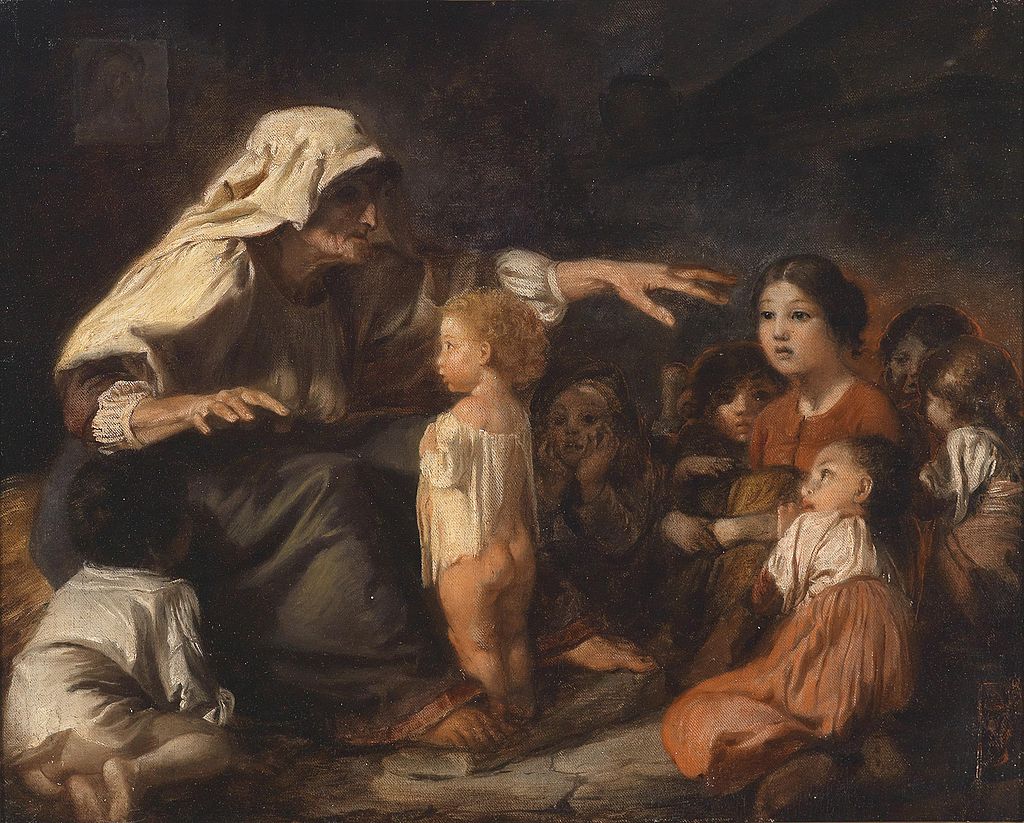
Spannende Geschichte. Öl auf Leinwand, Provenienz: Nachlass Clemens von Franckenstein (1875-1942);  
 Wikimedia Commons / Public Domain

Each of us have our own internal stories we tell ourselves and those around us. They can be as simple as how we learned a certain skill and as complex as a long and bumpy road toward motherhood. They shape who we are and what we become. They affect our outlook and how we interpret and react to interactions with others.

Long before people where commonly able to read and write, the tradition of oral story telling was used to teach and shape the people who heard them and they way they behaved and made choices. These stories had the power to spark strong emotional reactions, help us understand the mysteries in the world around us, transfer vast amounts of practical knowledge, connect people from drastically divergent backgrounds or even lead entire nations of people to war.
 
To understand the importance of stories, one need look no further than the Bible. Suggestions, instructions, rules and commandments are simply not enough to move human nature toward a better way of thinking and acting. God knows this and so do we. It is only through the sharing of historical narratives, allegories, parables, poems and songs that we begin to understanding and internalize the lessons of human nature, the laws of God and the effects of our choices.

Knowing the profound affect stories have on ourselves and our society, how important it is for us as writers to carefully select the stories we listen to, reinforce and share with ourselves, the people around us and society at large. There are far too many story tellers willing to strip us down to our lowest common denominators just to make a quick buck or get a little attention. We need more stories that inspire, uplift, and enlighten. We need stories that encourage us to magnify our better parts. It is our responsibility to write these stories and share them with the world. Writing is more than just a fun hobby. You have the power the change the world. Be sure you're changing it into the kind of place you would want to inhabit.

Saturday, August 20, 2016

Boring Secondary Characters - Line Up Here

By Lacey Gunter

As my kids and I were debating this afternoon about whether a certain character in a book we are reading is about to die in order to save a loved one, my son asked me "Why do characters have to die? Why can't they all just live and be happy?"

It was a simple enough question to answer, and it didn't take much explanation to convince my son that conflict, adversity and challenges make stories interesting and compelling. But reflecting on the question afterward, there seems to be an important life lesson here.

Most of us would like to think of ourselves as the hero or heroine in the story of our life. Perhaps a few might like to be considered as the villain. But none of us wants to be thought of as a boring side character with little importance to the story. Yet in the course of our life we are often prone to ask ourselves, why me? Why do I have to face this challenge? Why did God have to give me this adversity? We may even pray to God and ask, for the challenge to be taken away or easily solved for us. We just want everything to go the way it is supposed to and everyone to just live and be happy. Wow, doesn't that reek of boring secondary character, or what?

So here's where we look to literature for another important life lesson. Stop asking why me, why God please just take this away. Start praying for knowledge, blessings or opportunities to learn that amazing something special about you that will help you overcome your adversity.

I'm not saying we should go chasing down trouble. But at the same time, let's not cower to the margins of our book of life hoping to avoid it. This is your opportunity to grow and demonstrate just how awesome you can be.  Challenges and adversity aren't just what make a great story, they're what make us great. Be the heroine, not the boring secondary character.

Saturday, August 6, 2016

Talking Heads, Dialogue and Picture Books

By Lacey Gunter

The role dialogue plays in a novel can be complex, but is usually necessary. It is difficult to write an entire novel without dialogue. At the same time good dialogue takes skill and practice for it to effectively move the plot forward and help us to connect with the characters.

As with most things, the rules are different when writing a picture book. There is no rule for or against including dialogue in a picture book. In a little informal survey I conducted on a sample of newly published pictures books, I found that about half of the books contained dialogue and the other half had no dialogue. Moreover, among the books that did contain dialogue, a small portion of them only had dialogue through speech bubbles within the illustrations which were not a necessary part of reading the text. So, less than half of the books actually had dialogue that was integrated into the text. At the same time, some pictures books are classified as dialogue only picture books.

So what exactly are the rules for dialogue in a picture book? There are really only two rules that I know of.  The first rule is don't let the dialogue detract from the visual experience of the book. That may seem obvious, but it is easy to violate if you are not actively considering it. A section of dialogue that sets up a conflict or reveals aspects of a characters personality may work great in a novel. But in a picture book it can turn out to be just a bunch of pictures of talking heads, not very much for the illustrator to work with and not very fun for the reader.  There is a fine balance required between dialogue and action for a picture book to still be a satisfying visual experience.

The best way I know to recognize when dialogue is a problem in a picture book is to put on your illustrators hat and ask yourself, "If I were an illustrator, how would I illustrate this?" One technique is to break the text of your picture book into the 24-28 pages of text and then describe or sketch an image for each page of text. This is called story-boarding and you don't have to be an illustrator or good at art to do this. It will help you recognize if a section of text is going to be difficult or boring to illustrate.

If all you can think of to illustrate the text are two people sitting or standing together talking, this is a problem. Even two or three pages of this will get old quick. If this is the case, time to edit. Consider condensing or removing some of your dialogue. At the very least get your characters moving. Get them doing at least a few other actions while they are talking like baking cookies, or planting a garden.

The second rule only applies to nonfiction or nonfictionesque books, picture book or not. When using dialogue in a nonfiction or historical style picture book, be open and honest when dialogue is invented or assumed rather than an actual quote. This really should be open to the reader, meaning the child, not just a parent who might have to hunt for it in a bibliography or small side note at the end.

So play around and have fun with dialogue in your picture books. But remember, picture books are more than just a short story or a beautiful sounding section of text. Picture books are a fully visual experience. Talking heads, move along.


Saturday, July 23, 2016

Here's to 15 years....

Lacey Gunter

Most of us like a good love story. We root for that destined couple to figure out they adore each other and we wait on bated breath for all the pieces to fall into place. Then when they are finally together and the story closes out we imagine their happily ever after.

What does happily ever after look like? Ever is sure a long time. It would be pretty boring if it were all smooth flat sailing. It pretty much demands a climb. We don't really think of that climb when we imagine what happily ever after looks like.  But our imagination of that happily ever after is usually pretty short lived isn't it. If it was a really great story we might mull over it for a couple weeks, at most obsess for a couple months. But in real life, a love story that lasts a couple months isn't much of a love story.

My husband and I are about to celebrate our 15th wedding anniversary.  Fifteen sound like such a large number. Neither of us really feels that old. But both of us feel grateful the other person has stuck around that long and has continued this journey together.

Happily ever after is definitely a climb.  Stagnation never feels very happy. Growth can really hurt, but pain and happiness are not mutually exclusive. Sometimes we might feel like we are dragging our partner up the hill, kicking a screaming. Other times it may feel like our spouse is so far up the slope we're not sure how we will ever catch up. But the key, to me, seems to be to just keep climbing. We are not always holding hands, in perfect step with each other. But those moments when you both reach a peak at the same time and you turn around together to see the breathtaking view are as much fairy tale as anything I know.

Here's to fifteen years....going on ever after.

Saturday, July 9, 2016

Extreme Word Dieting

By Lacey Gunter


Being a picture book writer, I spend a lot of time trimming out words. With the average picture book manuscript expected to be 500 words or less, every word counts. When people are often touting how many words they wrote during a certain period of time, I am often thinking about how many words I was able to eliminate.

Unless you are also writing for very young children, this is probably not a big worry to you. But there are many situations where a WIP needs to go on a serious word diet. The typical writer usually approaches this using techniques of elimination. Unfortunately, these techniques are often slow and difficult. If you have a lot of time on your hands and you like the hard work, great, keep at it. For the rest of us who are strapped for time, and really hate having things taken away, an addition technique may be just what you need.

Remember when you were young and you would strain to get a Band-Aid off ever so slowly, thinking somehow if you went slow enough you could just avoid the pain and your mom or dad would suggest just ripping it off quick and then the pain would all be over. Well, word dieting can work like that too. Instead of slowly and painfully removing a word at time, it might be better just to take it all out at once. You're probably wondering how in the world you trim off a large portion of your manuscript in one quick stroke.  Well I was speaking literally, as in take it ALL out, every single word. Open up a brand new blank writing document and there you go, all gone. Whew, Band-Aid off. That didn't hurt so much, did it?

Now that that's done, the rest isn't quite so bad, because all you have to do is add. People like adding, it's much more enjoyable than having things taken away. The only difficult part is playing gate keeper. But you can open and close doors pretty well, can't you? You've been doing since you were like 2-years old.  Simply let in only the parts that absolutely need to been there. With everything else, just keep the door shut. This is most easily done by adding a scene at a time. Start with the most important scene in the manuscript. After each scene added, read or see what you have. Ask if the story can stand on its own, does it make sense, is it good? If not, add another scene.  If so, then it's time to stop and close the door.

If you are concerned about all the lovely or awesome writing you have left outside, don't worry, you can save the new version under a different name. The old version doesn't have to disappear. It can be there any time you need to just go back and look at it. It can even be mined for good ideas and good writing in your next project. But don't be surprised if after reading the old version, you prefer the new, leaner version better.

Saturday, June 25, 2016

WIFYR Class Summary: Notes on editing

By Lacey Gunter

I attended the Writing and Illustrating For Young Readers (WIFYR) 2016 conference last week. Probably the biggest appeal for writing conferences is networking, with agents, editors and other writers. This is the main reason I choose to go to conferences. But that take away is not something you can share with readers of a blog. What I can share with you, it the other main reason to got to writing conferences, motivation and instruction on improving your craft.

One of the classes I chose to attend at the conference last week was about revising and editing your manuscript, taught by Trent Reedy, author of Words in the Dust. I first have to say that Trent was a very entertaining teacher. He clearly knew how to engage an audience. Here are some of the nuggets I gleaned from his class.

The first thing that Trent emphasized was that the biggest process in creating a book is the editing.  But you can't edit something that has not been written, so the first crucial step is always to write. Get something down, even if it stinks. Don't let you internal editor slow you down and interrupt the process, just go with the flow and get the story down on paper.

Once you have completed you manuscript, the next step is to take a little time away from the manuscript. Take a vacation, pick up something new to work on or catch up on all the chores you put off while writing, whatever. That time away will help you gain a fresh perspective on the process.

Once you are ready to dive in, always work on the highest priority task first. He related this to his time serving in Afghanistan with the National Guard.  When opening up a new area in Afghanistan for operations, you don't go building the mess hall first. First you set up a security perimeter so that all you soldiers don't die trying to get started on every other task that has to happen. It is the same with editing a book, take care of the big picture issues first or you'll probably just end up wasting your time doing a bunch of small task that get deleted or written over later.

The highest priority in revision and editing is taking care of the action plot.  Does the story line follow a reasonable story arc? Try to map out the action that happens in your book. Does it have a clear beginning that sets up the conflict? Does the middle section build intensity based on the problems or obstacles the main character has to overcome? Is there a clear climax and a satisfying resolution? All of these should be clearly established and worked out before moving on.

The next priority should be emotional plot. How is the main character reacting and growing based on the action taking place in the plot? What is happening on the inside of the character? Is the character being stretched to grow? Will the result be satisfying to the reader?


At this point you can work on development of the minor characters and making sure you tie up loose ends. Book mapping may help with this. Trent suggested every author should work out a system that works best for him or her. The writing blog Fable and Fancy does a good job discussing how to book map here.

Finally, after you've worked out all the big plot issues and all the little subplot and character issues, it's time to look at sentence structure, flow of the writing and grammar.  How does the structure of your writing accentuate what is going on in the book. For example, if you are doing an action scene, don't write long sentence after long draw out sentence. Make them short and choppy and quickly moving to the next one. Reading your manuscript out loud can help with this. Trent also suggested Building Great Sentences: Exploring the Writer's Craft by Brooks Landon for help. For help with grammar he suggested Warriner's English and Grammar Composition by John E. Warriner.


In all of these steps of the process, it helps to get feedback from an outside reviewer, preferably many reviewers who are experienced in writing and editing books.

Well hopefully that gives a little guidance in revising and editing your next manuscript. Good luck my friends and write on!

Saturday, June 11, 2016

Does it Truly Matter?

By Lacey Gunter

We live in a judgement heavy culture. The rise of the internet and social media has greatly contributed to this way of life. Perhaps people have been doing this for millennia, but I doubt whether people have ever been so publicly vocal and its effects have ever been so broadly reaching.

Part of this tendency to judge comes from a sheer lack of understanding and fear of something new or different. But a fair portion of the time, I think is rests in lack of respect and the desire to control.

Certainly any Bible believing Christian can read Matthew 7 and understand this behavior of judging others is wrong. But we of the LDS faith must go a step further and acknowledge that no matter how much we try to shroud this behavior as "helping others make the right choices", when we attempt to control others, we are actually following the path of the adversary.

I'm not writing this blog post to persuade others to stop judging. But, rather, to share how I am working on curbing any of my tendencies to judge others. Because living in a culture drenched in a certain behavior can sometimes lead to spillage of that behavior within the walls of our own home. It takes a lot of mopping and bailing to make sure our homes stay safe and dry.

I am helping myself master the urge to judge by asking two questions. But it takes a willingness to be truly honest with myself and the faith to recognize that once I know the answer, I need to follow what it tells me.

So what are the two questions? Well the first question is "Is this something that really matters in life?"  Perhaps it needs to be a little more nuanced than that, but the idea is does this truly have a profound effect on my ability to live a happy and healthy life here on earth or my ability to become the person I want to be in the afterlife.  And likewise, does this truly have a profound effect on this person's ability to live a happy and healthy life here on earth or their ability to become the person they want to be in the afterlife.

When I can be honest enough with myself to determine the answer to the question is no for both me and the other person, then I know I need to take the step of faith to simply let it go. When I need help, I pray for the strength to keep my mouth shut and help my mind to move on.  It's not worth it.

If the honest answer to this question is that it directly affects my abilities to live a happy and healthy life and become the person I want to be, then this is the time for action. This is the time for courage to stand up for myself and take the necessary steps to bring safety and peace again in my life.

When it gets a little trickier is if the honest answer to the question is that it doesn't affect me directly, but it will probably affect the other person's abilities to live a happy and healthy life and become the person they want to be. This is when I ask myself the second questions, "Is it within my sphere of responsibility to help this person change their beliefs, actions or behavior?"

Is it truly my responsibility to point out the error of someone else's ways? When people are in imminent danger or serious harm, I believe this is a yes. And, as a mother, it is my responsibility to teach and inform my children of the potential consequences of their actions. But what if it's not my children?  Am I truly enough of an expert on the subject matter to know if their ways are actually errors? Am I feeling inspired to share Godly wisdom with this person?  Will the information or opinion I share with this person help their life, or will it just serve to make them feel bad or ashamed.

When I cannot answer yes, then I must have the faith to know that God will look after his child. It is his responsibility and he will fulfill it much better than I ever could.

If I can truthfully answer these questions and act accordingly, I am much better at not judging the other person. I don't have to, because it's doesn't matter or it's not my responsibility to judge.

LinkWithin

Related Posts with Thumbnails