Wednesday, January 15, 2014

Our Responsibility as Writers

by Anna Jones Buttimore
Sherlock Holmes - not a fan of Mormons
My husband served his mission in Russia. On more than one occasion he came across someone who said that they knew something about Mormons and didn't like them. When he asked what they had heard, they referenced the Sherlock Holmes murder mystery, "A Study in Scarlet", in which Mormons are depicted unfavourably.

So let's just clarify that. Here are people living in immediate-post-communist Russia who get their expertise on Mormons from a nineteenth-century English author who had, at the time he read the book, never actually met a Mormon.

As writers, I think we should remember that people believe what they read. Words are very powerful; after all, they are how we learn. Even when you're writing fiction, it's important to check details about your location, history, and anything which is based on reality to make certain that it is honest and accurate.

I'm currently writing a book set in Wales which talks a lot about the landscape, language and traditions. It's possible that there will be readers who know nothing at all about Wales, apart from what they read in my book. So it's my responsibility to make sure I don't say that the weather is always warm, or that there are five times more sheep in Wales than people. (There are actually just three times more sheep than people in Wales.)

Remember, if you write a book about something, then for some reader out there you may be the authority on that subject. After all, you wrote the book on it.

Tuesday, January 14, 2014

11 Reasons You Should Watch More TV

I'm absolutely standing behind this statement: You should watch more television. 

Okay, well, I don't know how much you watch, but I'm here to tell you that if you want to be an excellent storyteller, a weaver of words, you can gain a lot from watching television. 

Yes, OF COURSE, you need to read. You need to read in your genre, your genre-adjacent, your category, and whatever is selling like gangbusters. You need to read broadly and deeply and critically. None of that is new information, and I bet we could get into an internet-flame-war about how much reading one needs to do in order to be well-read (a topic for another time). 

But television can also hone your storytelling and writing skills. Here's how: 

1. It's fast. I can read critically and pick a book apart, examining it for structure and themes and arcs. If it's an adult epic fantasy (my poison of choice), it takes me usually around three weeks to finish. If it's a YA urban fantasy, it takes a day or two. I read Harry Potter and the Deathly Hallows in a little over fourteen hours, straight through. Guess how long it takes me to watch the movies? A little less than five hours. 

With television series available on Netflix and other streaming options, I can watch ten episodes in a single afternoon (not that I've actually done that or anything...*cough, cough*). 

You see a story arc that would have been spread out over months condensed into one sitting. It's easier to catch themes and see character and story arcs when the story is so compressed. 

BONUS: For those with ADD/ADHD or reading disabilities, watching television can help them learn the art of storytelling in a way that's more accessible. 

2. It's appealing. Lots of people watch television. Not very many people are buying books (in comparison). You wanna know what's gonna sell? Take a look at what people are paying attention to. Now, obviously, you can't (and won't) write a tv-series-in-a-book, but you can be influenced by trends. Melanie Jacobson wrote an adorable romantic comedy inspired by The Bachelor (Second Chances, if you're interested) and Buffy kicked off an entire generation of girly-girls-juxtaposed-with-violent-themes. 

By understanding what's popular, you can decide whether the manuscript you're working on is something that will sell at a traditional publishing house, through self-publishing, or if it needs to be trunked for a couple years. 

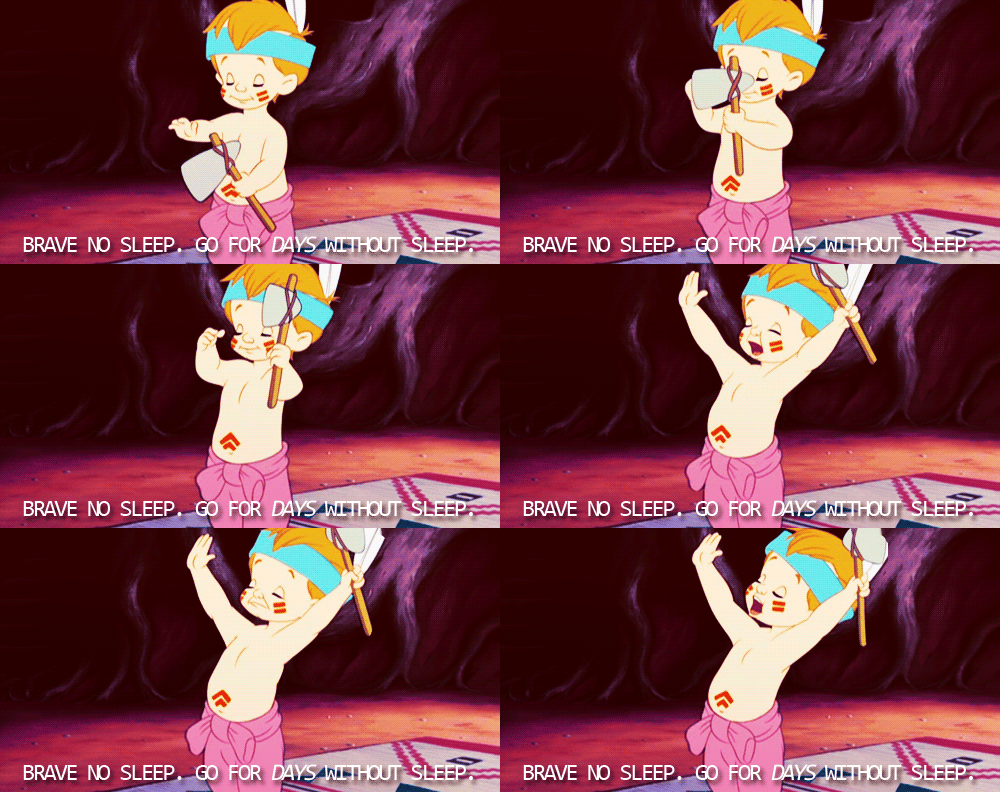
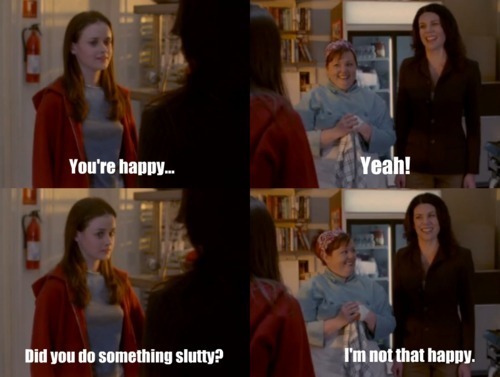
3. It's hyperbolic. In order to convey characters in sometimes as little as two or three minutes, writers resort to extremes. In the opening scenes of the Gilmore Girls, we see Lane skanking to Rancid and discussing her religious mother and her Korean heritage. We see Lorelai make a joke about being *ahem* promiscuous, and we see Lorelai and Rory bond in a not-normal-mother-daughter way. The chances of that all happening on the same morning? Hmmmm. Slim. Very slim. But it carves out who these characters are right away. 

When writing, you can do this, too. This is the infamous show-don't-tell at work. Don't tell us Lane is being raised by strict Korean parents who disapprove of her rock star ambitions: Show her avoiding those parents and gravitating toward the rock n roll. 

4. It's a veritable what-not-to-do. There's a lot of bad TV out there. A LOT. And by watching just some of it, and watching critically, you can see what not to do. You can find flimsy plots, poor character development, tropes, cliches, and just plain bad storytelling all over the place. 

The trick is to identify why it's bad and then comb your own writing for those errors and eliminate them. 

5. It's a more interesting version of school. True story: I know an author that needed to learn how societies fall and flourish for her fantasy world-building. She watched the Guns, Germs, and Steel documentary. It took her three hours. I read the book. It took me five weeks. 

Another friend said she learned a lot of terminology from a crime show (she then researched that terminology to make sure she used it right, but she wouldn't have even known where to begin if not for CSI reruns). 

Documentaries or shows dealing with real-life situations can help you get a feel for a subject you're unfamiliar with. Of course, you'll need to do more research if the show you're watching is dramatized, but television can give you a foundation and a passion for something you might otherwise not have known about. 

6. It's full of real people talking. If you've ever had a beta reader or CP say your dialog sounds unrealistic (and based on my experiences as a CP and beta reader, I'm going to guess that 90% of you have), you need to watch more people talk. Television is really good for this. 

It's even better than real people. 

Yes. It is. And here's why: real people have to think about what they're saying as they say it (ideally, they think about what they're saying before they say it, but let's not get carried away). TV people have the perfect thing already ready. There are no verbal pauses, there are no words being used incorrectly. It's perfect dialog. 

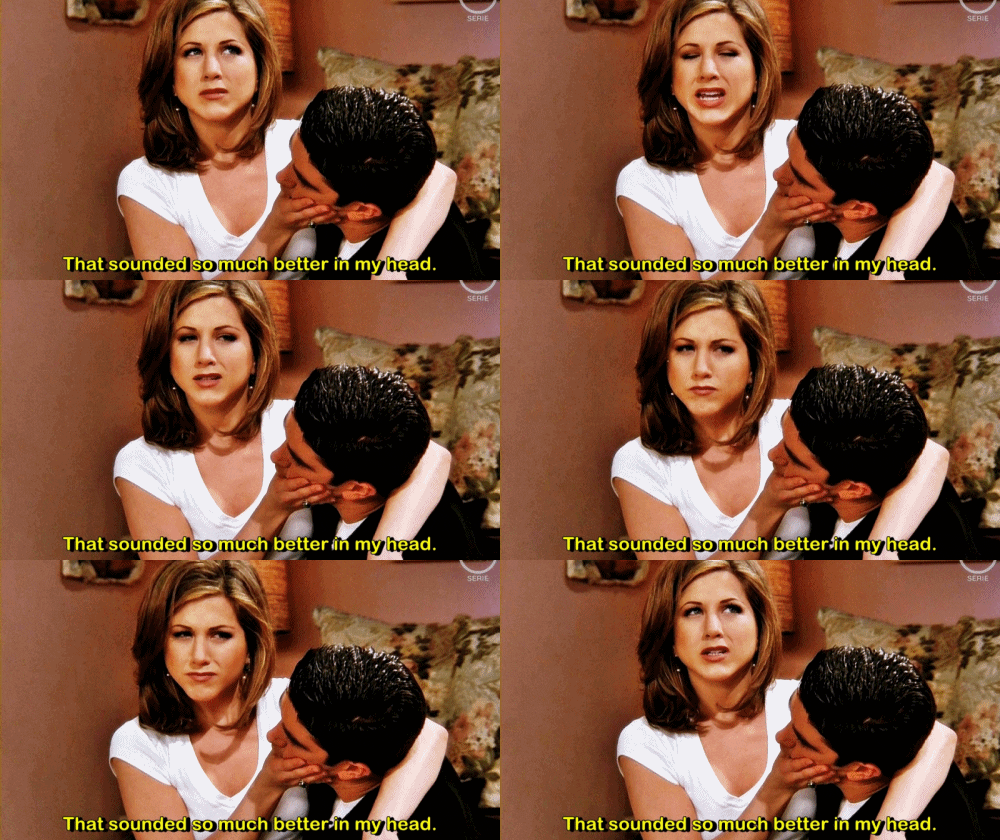
7. It's full of real people moving around and expressing themselves. You need help writing gestures people make while they talk? Or the way a fight moves around a room? Or how people's hands move on each others faces and bodies while they kiss?
TV will give you all of that. Pause. Rewind. Watch again. And again. (try getting the people at the mall to do that for you - it won't go well) 

8. It's visual inspiration. As my good friend Suz said, "One zombie scene is worth thousands of words." 

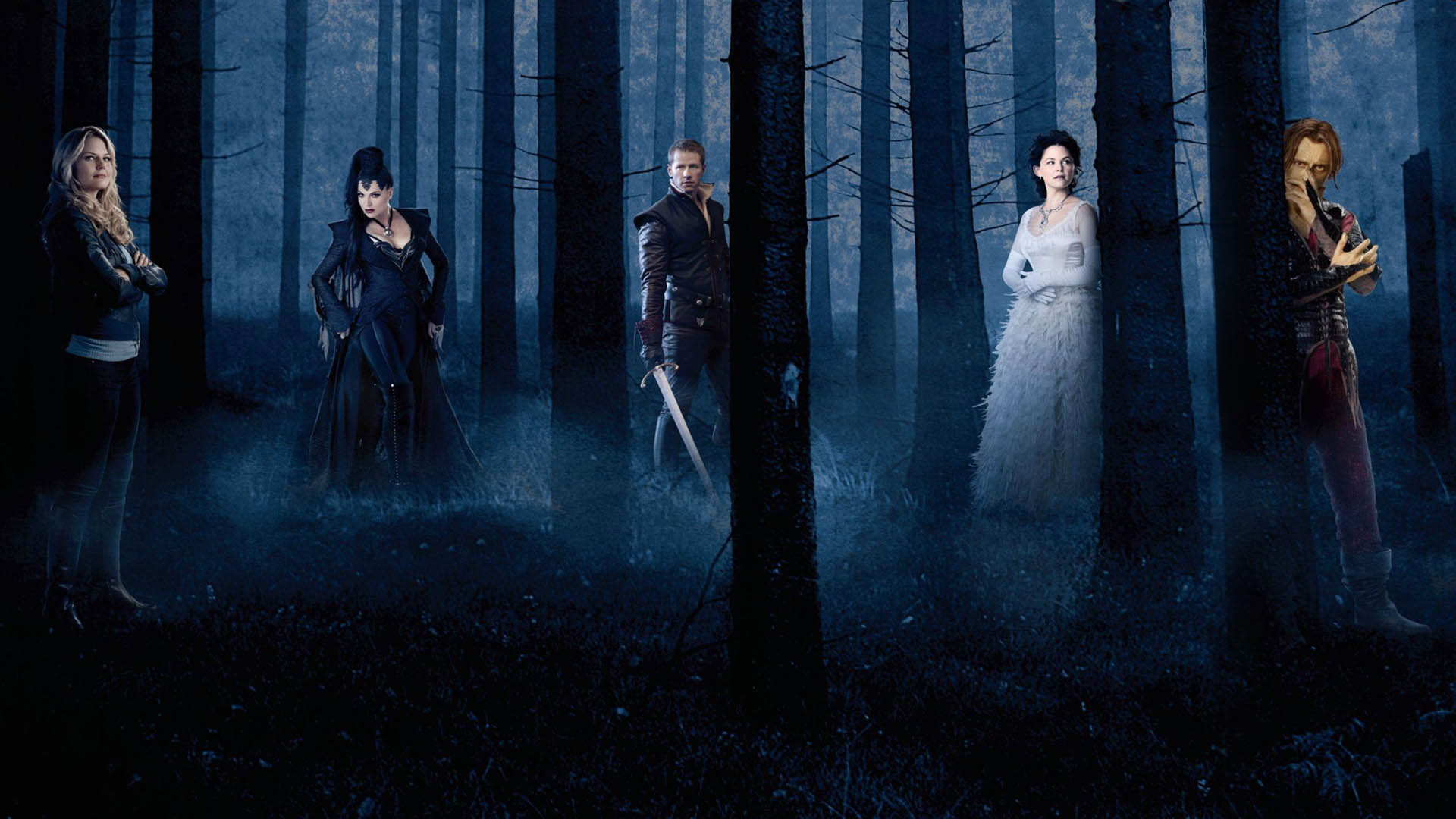
For those of you who pin visual pinspiration, or who scour modeling sites to find the right face to inspire your love interest or main character, try surfing the television. It's easier to get a feel for how these scenes and people can inspire you when you see them moving and living and being. 

9. It's easier to see what's happening. Television shows can successfully juggle dozens of viewpoints and storylines without losing the viewer (hello, soap operas!). Books often struggle with this (with the exception of the ineffable George RR Martin, of course). Watching an ultra-complex storyline full of dozens of intricate players can help you weave a more complex tale yourself. 

Even if operatic stories aren't your thing, seeing these complex stories woven together can help you understand literary devices like foreshadowing and red herrings and metaphors. Seeing them come to life is often easier than reading them. 

True story: while watching Monsters University, my seven-year-old noticed a very poignant piece of symbolism regarding Mike Wazowski stepping across lines. That would not be possible in a book: But he now has a grasp on metaphors and symbolic gestures in a way he could not have done otherwise. 

10. It's full of  hooks and cliff-hangers (and curb-hangers). A television show has approximately four minutes to catch and hold your attention before the first commercial break. And then they have to lure you back after a two-and-a-half minute break. Considering most sitcoms are only twenty-one or twenty-two minutes of actual showtime, that's a big deal. You're gone for one-tenth of their storytelling time. 

And yet they get you to come back. 

How? 

Curb-hangers. Smaller than cliff-hangers, but they leave a question in the back of your mind, something that makes you want to return to see how it is resolved. Then these same shows go away for a minimum of a week, but often as long as four or five months, expecting you to return. 

How?

Cliff-hangers. Television has perfected the cliffhanger. Indeed it was a silent-film serial that gave us the term, and we see it used so often that people expect them. So much so that I've seen a non-cliffhanger-season finale and thought, "WHAT? That's IT? We don't get a big cliff-hanger???" 

If you need help figuring out how to build to a climax and leave it unresolved, watch television. It will teach you. 

11. It's a mental palette-cleanser.  This might be the most important reason of all. Television tells a story in a very brief amount of time - usually a complete conflict and resolution in just over twenty minutes. Some picture books take longer to read than that. You can watch something quickly, or watch a lot of somethings in a row, and get a much-needed break from your writing. 

My favorite shows to watch for storytelling elements are How I Met Your Mother, Gilmore Girls, and The Office. Others have recommended: LOST, Walking Dead, The Vampire Diaries, and Buffy.

What shows do you watch to learn about storytelling? What shows do you just like to watch? What storytelling tips and tricks have you gained from television? 

Monday, January 13, 2014

Improve writing skills... quickly?

One of my favorite things to do when I find a good article is analyzing their perspective.  I think it’s fascinating to see how perspectives differ from person to person, even when talking about the same subject.  The important thing is, as Baz Luhrman states; “Be careful who’s advice you take, but be patient with those that supply it.”  I like to take it all in, and then decide what I like, what works for me and how I can apply it.  The particular article that I chose to address is from ragan.com, 10 Ways to Improve Your Writing Skills-Quickly by Amandah Tayler Blackwell.  Now, I have seen a lot of lists on how to improve this or the other thing, but the part that snagged my attention is the “quickly” part.  I want to address a few of the ways she lists, and then come back to the “quickly”. 

    The first one made me think of Kasey’s post last week when she was sick.  I love how she makes is sound like she’s having all these great experiences, and then you realize that she is reading a story!  She cracks me up.  But I know that reading all these different stories and writing in your journal is a great way to come up with new ideas for writing.  Another great way, at least for me, is dreams.  I swear my dreams are so vivid, that I could get almost a new idea every night!  The ones that really throw me are the dreams that have a beginning, a plot and end!  I feel like I’m watching and participating a movie!  It’s kind of fun.

    The one that would be a challenge to me is her idea of rewriting your blog posts.  I definitely see the purpose in doing this, because it can help you to see ways that you can improve your writing.  I would have a difficult time sticking to this idea, unless I had to redo the post for something else.  I like the feeling that I am “finished” with something.  But I know that especially in writing, you can’t get caught in this thinking because writing is a process that requires a lot of rewriting. 

    I wanted to also mention one that I think we (especially us MMW bloggers) should pay attention to, and that is “commenting on your favorite blog posts”.  I get in the habit of reading something and then thinking to myself, “Wow, I really liked that.” and then moving on.  My goal is to stop and give some feedback when I read a post.  I love to see others comment on my posts. It lets me know where I can improve, it opens my mind up to other ideas and it also gives me motivation to keep writing because I feel like maybe I’m making a difference!  So when you read something you like (or even dislike) take a few moments and put down some constructive feedback! 

    Another favorite is “read beyond what you normally read”, but I’m not going to go too much into it, because I would like to see you guys read her article.  She has some great ideas!  The one thing that confused me a little, is that she didn’t go into how her list would help you get there “quickly”.  All of her suggestions were really good ideas, but  I am not sure I understand how it gets us there faster.  Any thoughts?  Check out the whole list!

Question to Ponder:
If you were asked to add five things to her list, what would you add?

Sunday, January 12, 2014

The Master Potter

For Christmas one of my daughters received a children's pottery wheel from her grandparents. Both of my girls were very excited to use it and make a little pot. It took some time, but soon enough my girls had learned how to press on the clay and shape it as is spun one the wheel. As I helped them and watched their little hands shaping the clay I couldn't help but think of the analogy taught in the church of the Potter and the Clay. 

There were some instructions that came with this little pottery wheel.  They were pretty basic and easy to follow.  The first step was to squeeze and squish the clay a bit in our hands to soften it up.  Amazingly, this is where the analogy begins.  Before anything can be made of us we must soften our hearts and be willing to be molded and shaped by The Lord, the Master Potter.  If we harden our hearts and become stubborn or proud the Lord will not be able to work with us and mold us into something better. 

The second step was really simple too, however the instructions emphasized that it was crucial this step was taken or we wouldn't be able to progress.  The instructions stated that the softened clay MUST be placed in the CENTER of the wheel.  If it wasn't centered the clay would be unbalanced and the force of the wheel spinning would either break the clay, or it would be flung off the wheel.  So it is in our own lives.  It is not enough just to soften our hearts; if we do not have a Christ-centered life we will break and be placing ourselves outside the “safety zone” of Christ’s blessings and protection.  If we have a Christ centered life and allow ourselves to be sculpted by the trials given to us by the Master Potter we will be strong and become a beautiful vessel that can benefit mankind and bring joy to our maker. 

The next step was where things became a little more difficult.  This was when we needed to start applying pressure to the clay.  This seems easy enough, but as we learned, there has to be the right amount of pressure.  We needed to have a steady hand and be gentle so we didn't break our fragile pot, but if we didn't use enough pressure the clay would not move or change.  How lucky we are to have a Master Potter that knows exactly what we require in order to take shape and grow. 
In our instructions it told us that there were many different shaped pots we could create depending on how we molded the clay and which tools we used to shape it.  So are we, as God’s children, capable of being many different things.  And just as certain types of pots or vessels have a particular purpose, so do each of us.  Heavenly Father knows from the beginning what it is we are meant to be, what we are capable of.  And it is our Loving Maker that knows just what tools to use to change us and help shape us into who we need to be in order to fulfill our calling and purpose in this life.


There were other things that were necessary for us to make our little pots.  The instructions informed us that we would need to keep the clay wet during the whole process so that our hands could slide across it.  If the clay became too dry it would “snag” on our fingers and hands, which resulted in a misshapen pot.  At one point this even caused my daughter’s pot to crack and break.  Like the clay we also need things that will make this sculpting process easier, things that will help lessen the friction and pain of difficult times.  Things like prayer and scripture study will not only help keep us centered on Christ, but will allow the Holy Ghost to dwell with us and soothe our “snags” or rough spots. 

The final step in sculpting a clay pot is to put it in the oven or furnace and bake it so that it becomes solid and firm.  Sometimes our worst trials are the things that make us the strongest, so long as we trust in Heavenly Father, the Master Potter.


But now, O Lord, thou art our father; we are the clay, and thou our potter; and we all are the work of thy hand” (Isaiah 64:8)


Saturday, January 11, 2014

The Power of Committment

By Lacey Gunter

Today I am delighted to attend the joining together of two lovely people, my dear niece and her wonderful fiancé. They are young and sweet and thoroughly in love.

Marriage is such a powerful institution. It compels us to be better than we were and to look outside ourselves. Committing to love and be with someone even when things get worse, much worse, is difficult and takes a lot of courage, strength and patience. Modern society doesn't seem to place as high of a regard for people keeping their commitments as it used to.

 In the Book of Mormona when the Nephitesb were in a particularly grievous battle with the Lamanitesc and the Nephites had gained a clear upper hand, Moroni, their leader said they were willing to stop the battle and bloodshed if the Lamanites were willing to promise not to come against the Nephites again in battle. While the Lamanites were eager to get out of the loosing battle they were in, they were not willing to make this commitment because they had no intention of keeping it. So they decided to continue to fight. 

I am always amazed by this story. At this point in time the Lamanites were not a very good people. There were not a lot of very pleasant words used to describe them. But they certainly had one thing going for them, they must have been men of their words. They must have believed strongly in keeping their commitments. Otherwise they would have just committed to the Nephites to get out of the bad position they were in and then broken their promise later when they came back to fight again. They apparently believed so strongly in keeping their commitments that they were willing to die over it. If nothing else, that impresses me.

How easily people in this modern day break their commitments when things get a little difficult or inconvenient.  But keeping your commitments can be such a powerful force for good. I am grateful for this opportunity today to be reminded of my commitments to my husband, family and my God. I pray for the strength, courage and patience to be at least as good as the Lamanites and honor my word and my commitments. 

It may seem small, but consider the example of Abraham and Sarah of the Old Testament. Entire nations can be born of that one small commitment. And studying a little genealogy can teach you how much of who you are came from who your ancestors were. Our faithfulness to that one small commitment can ripple down through the generations of our posterity and have the power to effect the course of entire nations. That is powerful.


a The Book of Mormon is another testament of Jesus Christ. It is the record of the people who lived on the American continents before, during and a little after Christ's birth, ministry and resurrection
 bThe Nephites were a people living in the Americas thousands of years ago before and during Christ's time. At the time of this reference they were faithfully living God's laws
cThe Lamanites were also living in the Americas at the same time but they were usually not living God's laws and often went to war against the Nephites

Friday, January 10, 2014

A Deadline Come and Gone

by Mare Ball  Adventures in the Ballpark

Wow.  I haven't done any work on my WIP for almost three weeks.  This is the longest amount of time I've not looked at it in a year.   Here are my excuses:

Christmas celebrations ate a good week.
I got a cold/sinus/flu-type bug that knocked me flat for another week  (I'm STILL hacking.)
I went to see Frozen and Catching  Fire.
I ate too many Christmas cookies.
I lost my motivation.

I beat myself up about it for a couple days....and then, today, I sat down at the computer and opened my book proposal file.  That led me to check some other files, which led me to my blog, and then this blog.  I read in a former post that my goal was to finish my book by November 30.


That bummed me out.  My book is 75% done, not 100% done.  How did I end up at January 10 with a still incomplete book? 

I paused a long time before I wrote this sentence.  Because, I don't have an answer.  I don't know what happened.  Life happened.  Stuff that was not writing stuff.  Good things, and frustrating things, and time-consuming things.  I don't know.

However - I do know this: every day, before I'm out of bed, I talk to Jesus in my head and thank him for my cozy bed and the rest I just gained.  I reflect on the day before me, running through what I need to do - and I ask for His guidance and His blessings.  I invite Him into my day.  I relish that quiet time to connect with my Creator and just be still and be grateful.  I don't get up until I feel closure on that time.

Then I groan my way out from under the covers and face the day, whatever it's going to be.  I always have somewhat of a plan, but God likes to throw a wrench in that often, so I've learned to be flexible.

And here's what I've concluded:  In God's view of my life, whatever my day entails, He is pleased if I'm honoring Him.  If I'm doing my best to be patient and sacrificial and grateful, if I'm using my gifts to help others....He's smiling.  Whether I'm writing, or not.  Sometimes I'm writing, sometimes I'm cleaning toilets.  Sometimes I'm taking Dad to the doctor, or trying to make leftover hamburger and goat cheese into something suitable for dinner. In God's eyes, what I'm doing is secondary to how I'm doing it.

I might be bummed about not meeting a writing deadline - a personal goal of mine - but God looks at everything I do.  And to Him, the writing tasks and the non-writing tasks are equal.  So whatever else I spent time on that kept me from meeting my November deadline....it was important too.  Time with family, movies with my girl, even sleeping for a week to knock out a nasty virus.  They were not insignificant events.  They were just not writing events.

I want to keep my writing in perspective.   I want to do my best, of course, to complete my book and get it published.  I pray for God's blessing on that.  But, I don't want to feel guilty or beat myself up if I fail to meet to a self-imposed deadline.  I simply want to do the best I can every day, at whatever I'm doing.  Writing is important, but it's not more important than everything else.

Now....my next deadline to complete my book is February 28.  We'll see how that plays out.

How do you feel about failing to meet a deadline?


Monday, January 6, 2014

Oh, The Places You’ll Go

by Kasey Tross

The day after Christmas I came down with the flu.

But it wasn’t all bad- I spent the next day with my friend Kyra. She’s a fashion designer from New York City. After her hot Irish boyfriend started making it big as an actor they moved into a HUGE house in Beverly Hills, which was great until the Oscar buzz led to a bunch of paparazzi stalking them everywhere. I mean, it was great for her fashion design business (seriously- how else do you get to design gowns for the Golden Globes and the Oscars?) but it made her crazy and it was way stressful on their marriage. Fortunately, they’ve reached a compromise and they’re making it work. And her designs are more popular than ever.

The day after that I was with my other friend Gaby at her farm in Massachusetts. In the years since her husband passed away she’s had a hard time, but she decided she was finally ready to love again, and she sent a video message to her children to let them all know she was getting married- on CHRISTMAS! So she got them all home- mostly because she refused to tell them who she was marrying until the wedding. In fact, she didn’t even tell the GROOM! Yes, she had 3 different men propose. She’s awesome like that. Well, the family all came and the barn was all decked out in white lights and it was so beautiful- turned out they even made it a double wedding. ;-)

The next day was probably my favorite- I took a train trip. I went all the way across the country- first on the Capitol Limited and then on the Southwest Chief. The people I met on that trip were a trip in themselves- there was Regina and her mom, both long-time train workers who had some amazing stories to tell, then there was the famous director and his writer and assistant- they were always   making things more interesting. There was Tyrone, the singing bartender who bore a startling resemblance to Elvis, then Father Kelly, the retired minister. Oh, and of course Tom and Julie, the engaged couple that actually got MARRIED on the Southwest Chief. If it hadn’t been for the avalanche on the other side of the Raton pass in Colorado, it would have been a pretty pleasant trip. But they got us out, and even with that, it was a lot of fun, mostly thanks to the great people I met.

In case you hadn’t guessed, I didn’t actually do any of those things. But I did read 3 different books that almost made me feel like I actually was doing those things!  I read "The Year of Living Famously" by Laura CaldwellI,  "The Christmas Wedding" by James Patterson, and "The Christmas Train" by David Baldacci.

 I felt lousy, and I slept a lot, but the one thing that kept my mind off of how awful I felt was reading. Thankfully, my husband had the week off so that I could stay in bed and sleep and read. When I read, I felt like I was somewhere else, experiencing all sorts of wonderful things, and it really pulled me through my illness.

The experience just proved to me once again how powerful words can be. I could have just been lying around in bed feeling sorry for myself (and I did some of that too) or mindlessly surfing the internet, or staring at a TV. But those things for me are life-sucking. After I finish staring at a screen I usually feel even more drained. When I read books, however, I feel refreshed and fulfilled, my
imagination alive with possibilities.

Who knows, maybe someday some other poor soul will by lying on their sickbed and something I will have written will allow them to forget about how lousy they feel for a little while... ;-)


Sunday, January 5, 2014

New Leaves


 “I keep turning over new leaves, and spoiling them, as I used to spoil my copybooks; and I make so many beginnings there never will be an end. (Jo March)”
―
Louisa May Alcott, Little Women

It’s a new year and that time to reflect on the last year and make new goals. I know a lot of people don’t like making goals for fear that they may not accomplish them. I love the quote by Walt Disney, “Around here we don’t look backwards for very long… We keep moving forward, opening up new doors and doing new things, because we’re curious… And curiosity keeps leading us down new paths.”


We all have the ability to succeed, but it is our responsibility to do it. No one else’s.  I remember when I was about 14 I would come home from school and watch Oprah. I enjoyed her show and I loved her story. Oprah is a true testament of coming out of a bad situation and having success. She said, “I want every day to be a fresh start on expanding what is possible.”


Yesterday my daughter got baptized. She is my oldest and so of course I was emotional. Brooklynn is the child that we adopted. For the past few months I have been thinking about how her life would have been if she didn’t come to our home. I don’t know exactly, but I know that they have struggled and recently she would not have been with her birth mother. She wouldn’t have been taught the gospel in her home and the environment is much different than it is in our home. I am thankful that I have my precious girl. I am proud of her for her decision to be baptized and become a member of this wonderful church of Jesus Christ. She is starting out fresh and clean, she will be able to make her own choices in life. Yes, there are going to be many that can affect her and some that will tempt her, but ultimately it is her choice.

We have the same opportunity every day. I get the chance to wake up and choose to be happy and love others. Some days are hard, sometimes I have people who affect me in a negative way. Over the last year or so I started to choose who I wanted to affect my life. I asked myself, “Do they make me feel good about myself and uplift me?” I am so much happier. I love my family and some days I am perfectly content staying in my little home with my husband and kids doing nothing at all. We all have choices and we are all going to make mistakes, but it is what you do with those choices and mistakes that make you who you are. I wish everyone a happy 2014. May all your dreams come true!

“Isn't it nice to think that tomorrow is a new day with no mistakes in it yet?”
―
L.M. Montgomery


Thursday, January 2, 2014

Writing Routines

by Katy White

Like most of you, I'm thinking seriously about the New Year and what I want to accomplish.  My goals are ambitious, but that's the point, right?  

-Get the two books I wrote in 2013 query ready,
-Query one or both of them,
-Land an agent, and
-Write two more books.

Okay, looking at this, I kind of want to pee my pants a bit.  But I also really, really want to do it all.  

Who doesn't?

To prepare for my über, ridiculously successful 2014 that I'm totally going to accomplish (totally), I've been reading the routines of famous writers.  Their routines were interesting, as were some of the superstitions (seriously, Jack Kerouac, the moon was not out to get you), but none of them told me anything new.  The consensus won't blow your mind.  

Writers write.

Whether it's "snap-writing," where you fit writing into the tiny chunks of time you find yourself with throughout the day--five minutes here, eleven minutes there--or hiring a babysitter once a week, or carving out a chunk of time before the kids are up or after everyone is asleep.  Writers write. 

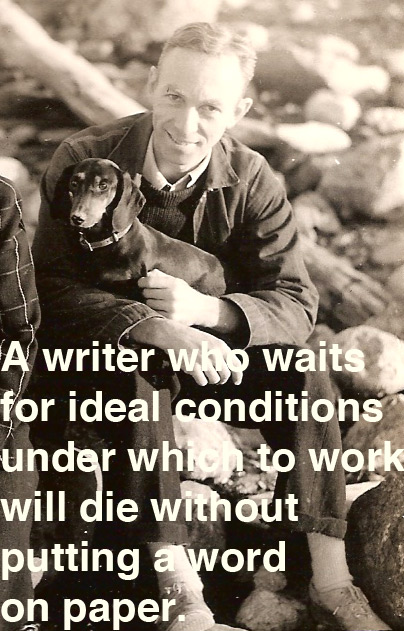
One quote from E. B. White has become my theme for the new year:


Testify, brother.

In addition, I came across a blog post by Shannon Hale who said the following about writing and being a stay-at-home mom (she has four children under the age of nine, including twins!):
"If you'd be just as happy knitting and mothering or scrapbooking and mothering as writing and mothering, then by all means, do those instead.
But if you can't, then you know who you are and what you need to do."
I know what I need to do.  I know what all of us who call ourselves Mommy Writers (Mormon or otherwise) need to do.  Not because it's a hobby or something we do to pass the time when we're out of bonbons and have finished reading the latest issue of Harper's Bazaar.  But because we love it.  Because we can't stand the suspense, wondering what the characters in our minds will do and how the stories racing around our brains will end.  Because we'd rather have dusty blinds and a pile of laundry up to our ears than not do what our soul yearns for.

Put words to paper.

Write.

Good luck to all of you in the New Year!

Wednesday, January 1, 2014

Happy New Writing Resolutions


Happy New Year! I hope 2014 brings you (and me) a contract with a big six publisher, and huge success with your best-selling novel. First, however, you probably need to finish writing it.

I made way too many resolutions last year, and so this year I want to go a bit easier on myself. So here are some writing resolutions you might consider which are a little more fun and achievable than the usual "write 2,000 words a day".

Read a lot more. 
Apparently I read 26 books in 2013, which was fewer than I had planned, but still not bad. Reading is pleasurable and relaxing, and it really does help make your writing better. As you read, you pick up by the easy process of osmosis all the things you need to know - like whether your hero has pecs or pecks, and keeps his gun hidden in his sock draw or his sock drawer. Both these are mistakes I have come across in my editing work, and the only reason I know which is correct is that I read a lot, and I see and remember the correct version in context. 

If you read a lot of good books you will also absorb the habits of good sentence structure, good descriptive writing, and see how expert authors craft their stories. How can you hope to emulate what you've never studied?

Join a writing group.
I belong to two, and I really enjoy them both. We undertake difficult and challenging writing exercises, we critique each other's work, discuss issues around writing and publishing, and we learn a great deal - and have lots of fun - during our monthly meetings. Writing need not be a lonely endeavour. Even if you can't find a writing group nearby, there are plenty available online.

Write 350 words a day, with weekends off. 
This is recommended by novelist Chuck Wendig, whose blog I would link to but there's a load of swearing on it so if, unlike me, you're someone who isn't offended by such things you'll have to find it yourself. Anyway, in between the crudity and horrible misuse of the worst words in our language, Chuck make an excellent point, which is that 350 words per weekday is a "one pushup a day" goal. It's easy. This blog post is already longer than that. But you still end up with a 91,000 word novel at the end of the year.

Take Part in JanNoWriMo/Camp Nano/NaNoWriMo. 
National Novel Writing Month has grown somewhat. Not only is it now international (I'm proof of that) but it's not just for November any more. Note that your goal is not to win it, but just to take part. To register, to communicate with others doing it, to drink in the advice and camaraderie and, yes, to have a good stab at writing a lot of words in a short period of time.

Write anything. 
Stuck on your novel? Write a letter or email to someone. A blog post. A poem. But write something each day. Some days maybe you will write 2,000 words of your novel. Other days you'll just write a Facebook status update. But that's OK if your resolution is just to write, not necessarily to write your novel.

Write one word a day. 
At one of my writing groups we set monthly writing goals, and my friend Hellen often picks this one. One member of the group was somewhat confused by it: "Why just one word a day?" The point is that by the time you've sat at your computer and opened your novel it's unlikely that you will stop at one word. Some days, of course, you might (and that word might be "Chapter") but that's fine, you can still pat yourself on the back because you have achieved your goal. But most days you'll do much, much more.

So there you have it. Six easy writing resolutions which don't put you under too much pressure, but can still help you to write that masterpiece this year. Which will you choose?

LinkWithin

Related Posts with Thumbnails