Thursday, June 9, 2016

Prudence


Why, is it so difficult to find current young adult fiction that is G-rated?

I love to read YA because...with this genre I get to momentarily feel young again! As readers we get to live vicariously through the eyes of these wonderful young characters. YA books can truly be great escapism. The main reason I read YA is that I need to screen for content as I have three daughters; ages 13, 14 and 16.

And…I’ve officially become a prude.

I move that the young adult label actually be restated to say “18 to 25.” That’s a young adult, right? Or would that make it actually just for plain adults. I sort of doubt that 18 year olds want to read about 16 year olds though, as they are undoubtedly now dreaming of 21 year olds? It seems that our 13 year olds want to read about 16 year olds. Hmmm…complicated. Might need to work the kinks out of that relabeling idea a bit.

Now it’s one thing for me to read about teens sneaking out, or worse, sneaking boys into their rooms (cough…”Twilight.”) I’m old and married, and way beyond that phase. But my girls cannot read of such things. I don’t want them getting any ideas. Many books and movies seem to almost give our kids a playbook for doing such things. It scares me. Maybe these YA novels should go in the horror section for parents.

I pulled up Goodreads and asked for G-rated books. I wasn’t very impressed. If we are actually going to judge a book by its cover, some of the suggested top ones listed, look very romantic indeed. Maybe we need some really good mystery writers for our teens to come back in style. Of course having a love interest in a novel is, well, interesting. I like romance as much as the next guy. I love love. Maybe I just need to vent today because I am tired of naughty female characters. They really need to behave! (Can you tell I've been screening?)

It also seems that when a book becomes popular among the school kids, everyone else has to read it, too. Not good. Peer pressure of the bookworm variety. For some reason John Greene books have been big for the past few years. More sneaking out and more naughty kids. Ugh. My oldest child read his stuff and the younger ones will not!

This book sharing has been going on since I was in high school and that was ages ago. My first YA experience was “Fast Times at Ridgemont High,” and I can tell you that that book was a lot more graphic and detailed than the movie. None of you should EVER read it. My mother didn’t ever ask or care about what I was reading. She probably didn't feel the need to worry. But, boy did I sure got an education on some subjects no classes would ever cover. The funny thing looking back is that the girl sharing the book was our class president, and well respected by everyone. Her parents coached our sports and they were about as top notch a family as you could meet. Yet her parents bought her this book. I think 30 of us read that book before the movie came out. Thirty sweet innocent 14 year old girls had their minds blown that year.

I’d like to shelter my kids as long as possible.

Okay. I’m done venting. Thanks for listening.

If anyone knows of any really fun reads I’d love to hear suggestions.

Wednesday, June 8, 2016

Music

By Kathy Lipscomb

When I was a little girl, singing time was my favorite part of church. I sang my best, and I focused on learning each new song. I learned the hymns as we sang them, trying to pay attention to the words and learn what the notes did. I’m not some fantastic musician by any means, but I love, love, love music.

When my siblings were scared and my mom wasn’t home (we didn’t live with our dads), it was the primary songs that eased them. When my mom went through a manic phase, it was my voice ringing through the house “Love at Home” that calmed her down. When darkness took over my own thoughts, it was again, my favorite primary songs that gave me strength to resist temptations.

So when I heard that my oldest son, my sweet little sunbeam who loves to sing primary songs with me at home, doesn’t sing in primary, my heart broke. And then I paid attention to people in sacrament meeting, and noticed a lot of people don’t sing there either.

Why?

Our voices blend together. No one will hear someone who may not be confident in their singing ability. A new song makes singing difficult but not enough to leave the hymn book closed.


I’m not here to shame anyone. I genuinely wish that everyone would feel the strength from these songs that I do. Music, especially church music, has helped me, even saved me, so many times throughout all different stages of my life. And the music is meant to be a prayer to our Heavenly Father. He doesn’t care how we sing as long as we participate. Music is our plea to God, it is our prayer, and it is also an answer when we least expect it. It is our show of love to God and of God’s love to us.  

Monday, June 6, 2016

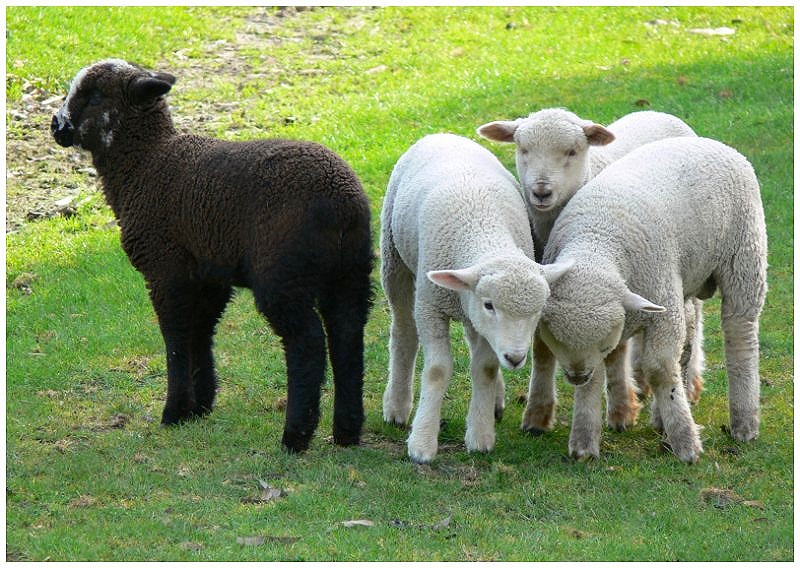
An Open Letter to the "Black Sheep" of the Mormon Church


by Kasey Tross

It's not often I post something specifically directed to our LDS readers, but I just felt like this was something that needed to be said, and it can probably apply to those of other faiths as well. 

For years I've been hearing a lot of people (women especially) calling themselves black sheep in the LDS Church, saying they don't "fit the mold" or that they aren't really the "Relief Society type."

Here's the thing:

There's no mold.

There's no type.

And the fact that you think there is a type is what's keeping you from feeling like you belong.

Despite what you might think, the Lord's flock isn't made up of white sheep. It's made up of white, black, red, yellow, orange, green, and blue sheep. Pink and purple ones, too. Spotted sheep, striped sheep, bald sheep, pretty sheep, ugly sheep, even sheep that look like goats! It's made up of every kind of sheep you can imagine.

I have been a member of the Church my whole life. I was raised in it, baptized when I was eight, and never had any period of inactivity, been faithful and true my whole life. There are many converts who might say, "See, you've been active in the Church your whole life- you've never drank or smoked or even cursed! You don't have tattoos, you've had all these leadership callings- how in the world could you understand me?"

Okay, how would one of those converts feel if I said to them, "See, you haven't been in the Church your whole life- you've drank and smoked and cursed! You have tattoos, you've never held a calling- how in the world could you understand me?"

It's the exact same opinion given from two different perspectives, yet each is equally harmful. The convert's opinion is perceived as complimentary while the lifetime member's opinion is perceived as derogatory, but the truth of it is that both opinions are devised to separate, to create division, to dig a gulf between us. 

Is that what the Lord wants for His Church?

No. But guess who does want that for the Lord's Church?

Whenever you find yourself wanting to step into your black sheep role, take a step back and consider where those ideas are coming from. Do you think God is happy when you shy away from church activities because you're not a "Molly Mormon"? Do you think He enjoys hearing anyone in the Church sitting around talking about 'us versus them'?

Were the people of Zion a Zion people because they were 'all of one past, and one experience, and dwelt in the same kinds of families, and there were no tattoos among them'? No, "the Lord called his people Zion, because they were of one heart and one mind, and dwelt in righteousness; and there was no poor among them."

"… for the Lord seeth not as man seeth; for man looketh on the outward appearance, but the Lord looketh on the heart." (1 Samuel 16:7)

The next time you're at church (or anywhere, for that matter), can you perhaps try to look beyond the outward appearance (this includes some of the things we say) and instead consider the heart? The very fact that someone is at church puts their heart in the same place as everyone else's there- including yours. We come to church not because we're perfect, but because we want to be better, and because we love the gospel of Jesus Christ and we want to follow Him.*

"The Church is not an automobile showroom—a place to put ourselves on display so that others can admire our spirituality, capacity, or prosperity. It is more like a service center, where vehicles in need of repair come for maintenance and rehabilitation.

“And are we not, all of us, in need of repair, maintenance, and rehabilitation?" (Dieter F. Uchtdorf)

Maybe you walk into church with your ink showing, or maybe you don't know how to bake a loaf of bread, or maybe you're a single mom working two jobs, or someone who doesn't really want to oppose gay marriage, or maybe you chose to focus on your career rather than get married and have children- do any of these things mark you as a black sheep?

No. They mark you as a human being who just walked into church, which makes you a human being who loves God and is seeking to learn and grow and follow Him the best way you know how just like the rest of us (and FYI, contrary to popular belief, baking a loaf of wheat bread is not a prerequisite for the celestial kingdom).

And if you're any of the above, please know that I love you and I welcome you. Because when I see you at church I know you are doing something that might feel scary, might be terribly uncomfortable, and yet there you are. That tells me you're brave and you're someone I need to get to know. Someone who is sticking with the flock even though it's hard. Someone who will get to learn and grow alongside me, someone who can teach me at the same time I'm teaching you: I want to see the gospel through your eyes.

I welcome you with open arms and will walk with you along this path we're both taking together. And while you might not be able to see my rough edges right away, trust me, they're there. That's why I need the gospel too.

But is everyone like me, welcoming you with open arms? No, they're not. Some are feeling insecure themselves, and don't think they're the best representative to welcome you into the Church, so they don't reach out. Others might feel just as intimidated by your appearance or your different perspective or your past experiences as you might feel of theirs, so they avoid you. Still others might be too distracted by responsibilities with church and family to take the time to connect with you, which is certainly a shame, but it doesn't necessarily mean they don't want to.

What I'm trying to say here is that while your feelings of being left out might indeed be valid, you still own half of this equation. You can choose to call yourself a black sheep and live up to everyone's first impressions and stay on the outside, or you can choose to reach out and open yourself up to relationships that go below the surface- both your surface and the surfaces of others- and by so doing bring your own unique experiences and perspectives to the table and help us grow together as a Church.

It's up to both of us.

So black sheep, white sheep, and every-other-color-of-the-rainbow sheep, I welcome the opportunity to see this gospel through your eyes. I'm ready to embrace you in this, the Lord's flock, and I know that's what our Shepherd expects of both of us.

Won't you embrace me too?


*Are there some people who come to church "to be seen of men" and not because they are eager to learn and worship? Yes. Is it our job to identify and judge those people? Nope.

Saturday, June 4, 2016

Sometimes It's Not You, It's Them

By Jewel Leann Williams

Statement heard in local American Night Writers Association chapter meeting (paraphrased):

“I’ve written a book, I pitched it, and it was accepted by XYZ publishing house. The editor had big plans, and then strangely rolled everything back and rejected it. I’ve been completely revising it and turning it into a completely different book. I guess my story didn’t have much to offer anyone.”

Let me tell you about the book this author is speaking of.  It is an inspirational memoir about her daughter and their experiences through a leukemia scare. 

I haven’t read the story, and I don’t know if it needs revision for the usual things we all have to revise, revise, revise in our stories. But one thing I can tell you, and I did tell her, is this:

OF COURSE YOUR STORY HAS SOMETHING TO OFFER!!

As a mom, I don’t have to have a child with leukemia to be inspired by another mother’s journey in that space.  I have other trials with my children and can gain insight and inspiration from what she went through.

Sometimes, it’s not YOU, it’s THEM.

Editors, publishers, agents are people. What’s worse, BUSINESS people. They have goals, agendas, business models—and each of them has a different one.  There are as many reasons for a rejection as there are rejections. 

I get it. I had a book I worked super hard on. I’d finished it, pitched it, got a “pages request” and sent it to not just the agent requesting, but every agent I could research who might be interested.  I thought it was ready, and it was rejected (a lot). It is one of the hardest things for me to pick that back up and work on it. But it’s a worthwhile project. The story is still, well, awesome, it has a great voice (says more than one of the rejectors), it just needs work. It doesn’t need the whole thing changed—just lots of polish. But man! It is HARD to put more blood, sweat, and tears into that project when my hopes had been so high, and then been smashed like a clam on a rock.
Mid nineteenth-century depiction of Josephine fainting after being told by Napoleon he will decree a divorce (to seek a male heir and royal alliance) Artist: Bosselman - Chasselat Public Domain in US (Public Domain in source country before 1996; past 75 years from artist's death)

But hear me now and believe me later (bonus if you know that reference):

Just because your book was rejected, does not mean that you need to change it into something different. What you need to do is:
  1. Consider the source and the content of the rejection. Sometimes it’s more about timing, marketing, and publishing trends than it is about the story itself.  Did you pitch a self-help book to an agent who only represents fiction? Or to an agent with a full list of authors in your genre?
  2. Realize that much of what is accepted and rejected depends on personal taste.  An agent or editor has to believe in your book to properly represent it. The publishing world is highly competitive for agents as well. Sometimes it just isn’t something that strikes their fancy, but there will be someone else out there who won’t be able to resist what you’re offering.
  3. Did you query too soon?  This was where my eager little self went wrong. I finished a book, loved it, and like an ugly baby with a doting mother, I thought it was beautiful and perfect.  Beautiful it is, but perfect—not by far. I should have gone through some real edits, beta readers, more edits, etc. and polished it more.  Make sure that what you are presenting is the best you can make it, and that you have had feedback and critiques to help you polish your product.
  4. PRAY about the feedback you receive. You have every right to ask for guidance. Don’t change things because some cranky editor who doesn’t like family stories or things that mention God or books with a happy ending (or a sad one, or one with puppies… etc. ad nauseum). Take the criticism, turn it over in your hands, consider it, and pray about it. You’ll know what needs to happen.

Here’s the thing.  I want you to remember this above all else.

Heavenly Father gave YOU the talent and desire to write. He has a purpose for blessing/cursing you with the need to express yourself with words.

He gave you that talent to bless His children.

You may not think that what you have to offer is anything special. But if you wrote it with the inspiration of our Heavenly Father, then you can rest assured that it is special and it does have something to offer the world. As such, you also need to include him in polishing your book, because just as He can transform people, He can guide you to transform your words into what He would have them be.

He will let you know what needs to happen, whether it is not to change a thing, to edit, to rework the whole thing, or to set it aside in a folder marked “Things I Wrote to Hone My Craft.” Or any myriad of other things. You just have to ask the Guy Who Really Knows.

Just remember—


Sometimes, it’s really not you, it’s them. 

Wednesday, June 1, 2016

Writing about Jerks (And Also My Relationship with Facebook)

- a post by Jeanna Mason Stay
Ask morguefile.com for a picture of
a "jerk," and this is what you get. Ha!
I couldn't resist.


A couple years back, I started working on a manuscript that involved a bad boy relationship in which the girl just couldn’t see what a jerk he was until she saw someone else in a similar relationship (the story was actually way more complex than that and involved parallel universes and an awesome scene with fruit-chopping ninja performers, but you get the basic idea).

As I was trying to write a relationship where this otherwise healthy girl was going out with this toxically awful boy, I realized I wasn’t equipped for it. I’d never been in a bad boy relationship. I never was one to date much, and I definitely tended toward the nerdy, nice types. Sure, I’d had my share of dumb crushes on boys who did dumb stuff, but I couldn’t imagine getting seriously involved with a real jerk without realizing, hey, this guy is a jerk.

I have a close friend who lived for a long time in a quite emotionally abusive relationship. Eventually, when she got herself out of it, she told me about some of the things that happened, and I thought to myself, “How do you not recognize that this behavior is terrible and manipulative?” It wasn’t that I was blaming her; it was just that I truly didn’t get it.

I ended up giving up on that manuscript until I did a little research. (Also because November ended, and it had been my NaNoWriMo project.) Anyway, fast forward to this past week when a friend of mine shared this article on Facebook. It talks about the chemicals behind bad boy relationships and why they’re so addicting. While I eventually had learned a lot of this, the article really laid it out nicely and concisely. I’m definitely going to be using it when/if I return to that manuscript again.

The upshot: Are you writing a bad boy? Do you need to get a grasp on what’s really going on internally? Read this article; you might find it useful.

Also, incidentally, I realized how much this article reminds me of my relationship with Facebook.

Monday, May 30, 2016

One Weird Question That Will Tell You a Lot About Your Protagonist


by Kasey Tross

I know that title sounds like click bait, but it's actually not (well, it is, but it's also true). This insightful- and odd- question came to me the other day due to a situation with a neighbor, and the question is this:

What happens when your main character is faced with a stick shift?

See, my neighbor had a situation (which was a whole other stressful thing I won't get into) in which she needed to move her husband's car. She got panicky because she didn't know how to drive a stick. I said, "I do. I'll move it for you." She handed me the keys, and I got behind the wheel of his turbo-charged, souped-up car. It was his baby. (He was in Indonesia.) I turned it on and it made that rumbly purr, which sent a little shiver of dread down my spine because it was in that moment I realized I haven't actually driven a stick shift in quite a long time, and the last time was my brother's elderly truck which required some finessing.

This car was anything but elderly.

Anyway, I very carefully eased it into first gear and out of the garage, and over to the neighbor's driveway where we'd been told we could park it for the time being. Everything went fine, and I felt a little twinge of pride and gratitude at having that skill, but on my way home later, I found myself thinking, "What would my MC do if she was faced with a situation involving a stick shift?" And, more importantly, "Why?"

Here are a few options for you (though the possibilities are numerous):

1. She would shy away. She's never driven a stick before, because they make her nervous. Nice, safe, easy-to-use automatic, please.

2. She would shy away. Her parents bought her her first shiny new car when she was 16 and it was an automatic. She's never felt the need to learn.

3. She would shrug and give it a go. She's got no other options and she's never driven one before, but how hard can it be?

4. She would hop right in and get going. She had a tough life growing up; all she's ever driven were clunkers with stick shifts.

5. She would reluctantly agree. She learned how to drive a stick once, but that was a long time ago, and she hasn't done it since. What if she messed up the car?

6. No problem. Everybody knows driving is way more fun with a stick shift!

7. She would smile and get behind the wheel. Her parents raised her on automatics, but those summers spent with Grandma? Well, they weren't exactly knitting the whole time.

A few more questions:

- Was whether or not learning to drive a stick a decision she made or a decision someone made for her?

- If she did learn, who taught her? What was the learning experience like?

- Is it a skill she has ever needed? Why or why not?

- Does this character's reaction to being faced with a stick shift surprise the people around her or not?

As you can see, this question takes you into your character's past, touching on past relationships and even socioeconomic status, and it also reveals quite a bit about her personality, both past and present.

If you're writing a fantasy or historical novel, then you might think this question can't apply, but what if your characters were transported into modern day, and they had grown up in a world with cars? How would their personality/status/relationships translate in a modern world?

I hope you take this weird question and get to know your characters better this week.


Saturday, May 28, 2016

My Summer Challenge to You

By Lacey Gunter

I am so excited for summer. My work as a professor dies down and my time with my kids ramps up. It's a time of free schedules, exploring creativity and lots of cuddles. Don't get me wrong, school is great and I love it. But there is something magical about summer's nonconformity to rigid topics and timelines that opens the world to new possibilities.

One of our favorite things about summer is the time my kids finally get to learn about all the topics or skills sets they wanted to during the year, but school got in the way of.  They take fun classes from the local university on various topics that interest them. We go to the library at least twice a week and check out bucket loads of books on all the crazy topics that pop in their heads.  And they finally have time to ask a thousand questions and I have the time to answer them.

Happily, this is an activity I love to take part in also.  Sometimes I will take a class with my kids or on my own. I often got to workshops or conferences. I try out new cooking, sewing, art and craft projects. And I greatly expand my reading as well.

The freedom of summer does not escape us, instead it expands us. This is the kind of learning that's not motivated by standards and competition, but by the rich feast it offers to the intellect and the soul.

This is why I want to issue a challenge to you. Find at least one thing new you want to learn this summer that will help expand you as either a writer or a mother or just as a person. But don't just pick something you've been told you need to learn or you feel you have to know to keep up with other mommies or writers. Pick something for the sheer joy of learning.  As it says in one of our LDS books of scripture, "The glory of God is intelligence." (D&C 93:36)  So make this summer glorious. Find some nook of God's intelligence and make it your own.

Friday, May 27, 2016

I'm So Glad We Had This Time Together

by Mare Ball @ Adventures in the Ballpark

Almost three and a half three years ago I wrote my first post for Mormon Mommy Writers. I was so honored to be invited to regularly write here. I've read so many sweet/informative/relatable posts here, and I feel connected with many of the contributors.

I'm so grateful for the opportunity to learn more about writing, the struggles of motherhood, and share issues of faith. When stumbling along this journey of life, communities of women are the best companions.

My life has changed over the past six months in ways that are demanding more of my attention, and I need to step away from a few things - including my time here. I hate that I can't do everything I want to do, but I don't think anybody gets that in life.  Maybe our expectations are too high, or maybe we just love too many things. Either way, my season here at MMW is closing.

I want to thank Nikki Wilson for inviting me aboard and Kasey Q her encouragement. I appreciate all the writers here who have commented on or enjoyed anything I wrote.  I'm grateful to all of you who shared your story. Writing is such a linking of hearts, isn't it?

I will always be grateful for my time here.  Welcome other writers like you did me. I'll be checking in, so keep up the good work!

I'd love to stay connected:

FACEBOOK

PINTEREST

BLOG Adventures in the Ballpark


much love from my Ballpark,

Mare


Thursday, May 26, 2016

Music as a Muse


By Patricia Cates

Most of us know why we write. We also seem to have a fairly good grasp on how to write. The question that looms in many, weary, writer’s-blocked heads, is what should I write?

The answer has not always been simple or clear. There has been much ado about the advice given years ago (by Hemingway?) to simply “Write what you know.” However many writers disagree. (Boy do they!) They see it as limiting. I will counter and say the most successful comedians who write their own stuff, who have done interviews, admit that they get most of their material from everyday events. It’s the hilarity that comes with family life or even their sadly laughable adolescent years that works for them. If you write what you do know you will surely still have to do research, just not as much. But maybe it’s not in the knowledge as much as in the experience itself, and the emotions attached, where we get our inspiration. No matter the genre, we will always need characters plucking emotion in fiction writing.

Soooo…If you have writer’s block and do not know what to write, I have a suggestion. Grab a note pad (or voice command device,) pull out your favorite records from when you were in elementary school, close your eyes and see what happens. Are you 10 again? Surely a vivid memory or twenty will come floating back. Some might make you smile and others could make you cringe...and that's good! The feelings attached to those settings you are now recalling could make for great fodder for your next chapter. Hey, maybe you can even derive a book from one of those memories. If elementary school is reaching too far back, try high school or college. Music can trigger long forgotten memories like no other. (So can smells but that would be much harder and…um…strange.)

Drawing from life experience is likely practiced by romance writers everywhere already. They write about their first crush and change the name, and the outcome! Writers create justice in their pages where none was found in real life, (like the school bully they put up with for seven years.) We see that all the time. The clothing styles and descriptions we can put our characters in from days past are fun as well. Sometimes we just need a memory jolt to garner those bold descriptions of things we have already seen and have forgotten. Big hair bands anyone? Spandex pants? Grunge?

But what about writers who want to focus on fantasy. Can they draw any benefit from this method? How do our past memories relate to a world filled with fantasy? Certainly one could base a character off an old long forgotten school chum. As an author you can give them a special power or gnarly facial warts. Your elementary school library can become a porthole for the children who read a specific book found on aisle A-F. That song you loved from 1987 can be playing in the background of your novel. When your fairy is awarded her first wings, use lyrics from your favorite victory song, just remember to give the band credit. In mystery writing that same friend you now remember from 3rd grade can be your supporting character and maybe even a suspect. I think pulling from our personal pasts is great and music can help get us there.

Do you need a setting? Could the music you listened to from the late 1990’s maybe remind you of a family vacation you took, and now you are suddenly transported back in time to that weird restaurant you happened across while driving? Voila! You have a new setting for your murder scene. After all the waiter WAS pretty creepy. All remembered because of a song you heard on the radio during that time.

But still stands the question of what to write! You are the only one who can answer this. Stop thinking so hard and just let it flow. Put your WIP down for a minute, get some Pandora or iTunes going and start jotting down your memoires. Let the music be your muse. I guarantee you that your fingers will start tapping pretty fast.


Wednesday, May 25, 2016

Writing and Prayer

By Kathy Lipscomb

I’ve finally realized something and I don’t know why it took me so long to figure out. When I feel anxious or resistant to doing something, like writing, it’s all the more reason to do it. And it’s okay to ask our loving Heavenly Father for help.

The first time I let people critique my work in front of me was at an LDStorymakers conference (I believe I’ve told this story). I was so nervous, so, so nervous that I contemplated getting out of my chair and running as fast as I could. Me. Running. I don’t run. I hate running as a general rule, but I was so sick to my stomach that it was a serious contemplation. After a silent prayer, God helped me through those thoughts, and before I could get up and run, the words I’d written came out of my mouth. I did it. I ended up with fantastic critiques. I had things to fix, but I also gained a little more confidence in my work—something I desperately needed.

I’ve since let many, many authors critique my work, and it’s scary every time. I keep waiting for that fear, that anxiousness, to go away, but for me, it hasn’t. I even get great critiques of how much an author loved it (not always J), but that fear comes back. Every. Single. Time.

Fear and anxiety are not from God. They are from the adversary. God wants us all to learn and grow, to develop our talents. He isn’t going to do things to make us stop, but the adversary will. Don’t listen to that fear. When you have a day that for some unknown reason you have such anxiety over writing that you would rather do anything else in the world…those are the days you need to write the most. The adversary will work against you. Fight back by praying for help. It’s totally okay to pray for help with your book. Now, I’m not saying you should pray to be a best-seller or famous or rich. But to genuinely pray that you will write a book to the best of your ability, that you will inspire and uplift your readers, that you will learn and grow in your writing talent—those are all great reasons to pray. Those are all ways to fight against the fear, the anxiety, the feeling of incompetence.


Pray. God will guide you. He loves you. 

LinkWithin

Related Posts with Thumbnails