Showing posts with label improving your writing. Show all posts

Saturday, October 15, 2016

The 40 Book Reading Challenge for Writers

By Lacey Gunter

My son's fifth grade teacher has issued his class a 40 book reading challenge. The challenge seeks to encourage reluctant readers to increase their reading and to expose avid readers to a wide array of literature. In addition to the number of books that need to be read, the students are challenged to read a minimum number of books from 10 different genres. I think it is a wonderful idea. In fact I think it is so wonderful, I want to issue the same challenge to all our blog readers.

 According to the Pew Research Center Libraries Survey of US adults in 2015, 27% of American adults reported that they had not read even part of a book within the last year. Among all American adults, the average number of books read in the previous year was 12 and half of American adults had read 4 books or less in the previous year.

I am highly confident that all our Mommy Mommy Writers and Friends do not fit the typical American profile and are among the avid readers who are skewing the average much higher than the 50th percentile. So the reason I am issuing this 40 book reading challenge is not to increase you reading, but rather to expand your exposure to a wide variety of good writing.

A good way to improve your writing skills is to study how the experts do it, and to see many different examples of how it is done, especially when it is done well. So this is, in part, to improve your writing.  But don't just stick within your genre. Much can be learned by examining writing from other genres too.  So here is my 40 book reading challenge to you:

In the next twelve months read:

Number                 Genre
2 Poetry anthology
3 Traditional literature
5 Realistic fiction
3 Fantasy
2 Science fiction
2 Mystery
2 Romance
3 Informational
2 Biography or autobiography
3 Picture book
2 Translated from another language/culture
2 Religious or inspirational
5 Bestselling or award winning book in the genre you write 
5 Free Choice 

Feel free to adjust this list to better suit your needs, but remember this is supposed to be a challenge to stretch you beyond what you would normally do or choose. Of course, don't forget to learn and have fun along the way.

Happy reading!

Saturday, September 13, 2014

A Writer's Gratitude

Recently our family has been going through some, well, we'll call them "learning experiences." If I were prone to whining I would tell you all about them, but you'll understand more about why I'm not exercising my whiner muscles in a bit.

The point is, it's been bad enough and we've tried everything we can think of to improve our situation for long enough, that the most effective of all weapons has now been in play for several months:

The Visiting Teacher.

My amazing visiting teacher has been praying for me, like always, but has been specifically praying for inspiration in her role as VT for ideas to help me in my current situation. A visiting teacher is a woman, part of a two-gal ensemble, who is charged with the care (spiritual, mental, physical, what-have-you) of her own little flock of ladies. It is a function of the Relief Society of the Church of Jesus Christ of Latter-Day Saints (oldest and largest women's organization in the world, woot woot!) and since each "companionship" has several sisters, everyone gets a little extra watching-out-for and we care for each other. So, MY particular visiting teacher takes her job very seriously and has been praying for ways to help me and my family.  She came up with this idea:

You think of the blessings you need, and you find the promise in the scriptures. Then, you work backwards from there. SO in my case, we needed financial blessings. We've got tithing down. She found scriptural promises attached to keeping the Sabbath, we are on that like gangbusters. In my studying, I found a biggie:

And he who receiveth all things with thankfulness shall be made glorious; and the things of this earth shall be added unto him, even an hundred fold, yea, more.  
                                       Doctrine and Covenants 78:19

So that's what has been on my mind, every channel, all day and night. How can my family be more grateful. I'm reminded of President Dieter F. Uchtdorf's talk about gratitude from the last General Conference, and how we have to have gratitude not just for THINGS, but for ALL things (same as the scripture above), and how it becomes not just "counting our blessings" but a true spirit of gratitude.

SO, how does this help me/you/everyone as a writer? I propose these ways. There are more, these are just my top three:

1) Look at the scripture. Made glorious. Things added--an hundred fold and more.  That's sorta self-explanatory.  There are promises made to the grateful heart. 

2) Having a spirit of gratitude colors your world. As my family and I have been concentrating on gratitude--true gratitude--and as I have been conscientiously seeking to find ways to improve my grateful spirit and heart, I find that trials don't weigh me down. The stinkin' finances don't occupy my every thought. There's more room in my brain for deep thoughts. I have more happiness and more inspiration. 

3) This is a developing idea--kind of my "next stage" in my gratitude studies. If we are grateful, we care for the gifts we are given.  We are good stewards of our blessings. So, we budget our money. We hug our kids and act like we actually are thankful for them, not that we want to strangle them and oh-my-heck will they just HUSH... sorry.  Work in progress.   

We GUARD our time. We DEVELOP our talents. We know we are blessed with the ability to put pen to paper and express ourselves, and because we are grateful for that gift, we don't squander it with clever Facebook posts and angry letters to school administrators.  I'm not saying don't do those things, just don't make that ALL you write.

What's holding you back from really diving in to your talent that the Lord has given you? Fear? Lack of time? Motivation? GET RID OF IT. Don't you bury that talent--there's no excuse for that. 

IF we are truly grateful for our writing talent, we will develop it and use it and turn it into a gift for the Lord. 

What better motivation is there than that? 

Gratitude is the ultimate writer's muse. 

(I have more on gratitude, but that's for another day) :)  Write on, my friends!

Leann


Saturday, May 24, 2014

Throwing Planks at Your Windows

Last weekend, I was listening to “Rosie on the House,” a home improvement radio show. They were at the Pella window factory (in Pella, Iowa!) and Rosie was squeeing like a fanboy at Comicon about all of the cool machines they use to test the strength, durability, and awesomeness of their windows. The Pella people put their product through a plethora of performance (p) evaluations, from extreme temperature ovens that subject the windows to extreme heat and cold. I won’t say what the exact temperatures are, because I don’t remember the exact ones. But it was in the “humans can’t survive this heat/cold” range—well beyond what a window should reasonably be expected to withstand. Pella has tests for “forced entry resistance” where they put pressure on the product to make sure it won’t be an easy target for burglars. Rosie’s favorite test involved a machine that hurls 2x4 planks of wood at the windows to test them for resistance to breakage.  Pella also pulls five windows off their assembly line and sends them directly to testing for performance ratings, compared with many manufacturers that pull windows, tweak and calibrate them, and then send them to the performance rating tests. The result of all the extreme testing is that Pella is considered one of the Rolls Royces of windows.
What does this have to do with writing? Well, Pella wants their windows to be the best, so they subject them to testing that borders on outrageously overdone—if the Earth ever got as cold as what they are testing their windows for, the occupants would already by dead. Winds strong enough to throw full planks of wood at windows would have already sent the whole house over the rainbow. Nevertheless, Pella knows that if it can withstand those extremes, then everything else will be easily overcome. They want to be sure that their product is the best it can be.
Are you willing to do that to your book/poem/short story/magazine article? We don’t have machines to test our writing—we have critiques and beta testers. Just like manufacturers (window, car, tire, etc.) throw their worst at their product, we should be putting our work through stringent and repeated testing to make sure it can hold up to the standards that editors, readers, reviewers will place on it.  If Pella wasn’t willing to have a few windows break in the name of quality, they shouldn’t be in the window business. If an author isn’t able to handle criticism, even blistering, scathing dislike, then maybe they shouldn’t be in the business. Think of the critiquing in your own close groups, or by family and friends) as heat or pressure testing. A beta read, on the other hand, is more like checking to see if your “window” can withstand a 2x4 at hurricane speed. You need to know if it can, before you send it to an agent.  Welcome the shattering—it means you still have time to fix your product before sending it out to the world.
So, your beta reader breaks your window—ouch. It hurts. The words you wrote came from your soul. This book is your baby—and this reader just called your baby ugly. How should you react? Well, first, don’t punch the reader in the face. You asked for a critique. Be grateful for the honesty.  Secondly, acknowledge that it hurts—but put an expiration date on the pity party. You need to give yourself permission to feel sad about the negative criticism for a few moments (or the time it takes to consume your favorite guilty pleasure treat, or a lunch with friends to commiserate). However, what you do next is what separates the amateur from the professional. Your next choice is whether you sit, with your thin skin, cradling your ego and stroking your “baby” muttering “what do they know,” and “Mommy thinks you’re just beautiful”—okay, I’m being extreme. But think about this—the energy you devote to building your ego back up, getting validation from others about your talent, focusing on how you feel, is energy that you could be spending making your book better. If the engineers at Pella spent any time at all feeling sorry for themselves when a window cracked in the oven or shattered when the board hit it, we would think they were ridiculous—just fix the product! It sounds heartless (and I need to take my own advice, trust me) but it is not about you, it’s about the writing.  A professional just gets back to work, figuring out what didn’t work, and fixing it.
I have chapters and trilogies full of thoughts about this, but you don’t have years (or patience) to read them. Here are a few:
Writing is a craft—yes, it is an art as well, but whereas an amateur relies mostly on raw talent, a professional practices the craft. Professionals are often not satisfied with their own work, because it’s not ready to withstand a hurricane yet—and amateurs think what they have created is so AWESOME that anyone with differing opinions is either mean, misinformed, or just doesn’t understand. Not all criticism is valid, but gives all of it serious consideration. As a professional, you can sift the wheat from the chaff.
A professional at anything separates themselves from their work, even as they throw everything they have into their work. The thick skin, the ability—no, the eagerness­­­­—to accept negative feedback, is a sign of true professional because they know that identifying flaws is the only way to fix flaws.
A professional never argues with criticism. The book is going to be sent out into the world defenseless, so to “yeah but” with your beta readers is pointless. If a beta reader has an issue then you can rest assured that other readers will too. Figure out the problem, and fix it.
A professional doesn’t throw the beta reader under the bus. By this I mean, that the writer shouldn’t kill the messenger, or try to make the beta reader out to be the bad guy. Even if your feelings are totally hurt, have the professionalism to leave them out of it. Getting other people to tell you that your beta reader doesn’t know what they are talking about, that your writing is amazing, blah blah blah, may make you feel better, but it doesn’t make your book better.  
Remember, it’s about the book. It’s not about you. Your book is a window—make sure it can withstand the hurricane before you send it out into the world. If someone finds flaws, fix them.

Have you had a critique that just crushed you? How did you use it to improve your craft?

Tuesday, January 14, 2014

11 Reasons You Should Watch More TV

I'm absolutely standing behind this statement: You should watch more television. 

Okay, well, I don't know how much you watch, but I'm here to tell you that if you want to be an excellent storyteller, a weaver of words, you can gain a lot from watching television. 

Yes, OF COURSE, you need to read. You need to read in your genre, your genre-adjacent, your category, and whatever is selling like gangbusters. You need to read broadly and deeply and critically. None of that is new information, and I bet we could get into an internet-flame-war about how much reading one needs to do in order to be well-read (a topic for another time). 

But television can also hone your storytelling and writing skills. Here's how: 

1. It's fast. I can read critically and pick a book apart, examining it for structure and themes and arcs. If it's an adult epic fantasy (my poison of choice), it takes me usually around three weeks to finish. If it's a YA urban fantasy, it takes a day or two. I read Harry Potter and the Deathly Hallows in a little over fourteen hours, straight through. Guess how long it takes me to watch the movies? A little less than five hours. 

With television series available on Netflix and other streaming options, I can watch ten episodes in a single afternoon (not that I've actually done that or anything...*cough, cough*). 

You see a story arc that would have been spread out over months condensed into one sitting. It's easier to catch themes and see character and story arcs when the story is so compressed. 

BONUS: For those with ADD/ADHD or reading disabilities, watching television can help them learn the art of storytelling in a way that's more accessible. 

2. It's appealing. Lots of people watch television. Not very many people are buying books (in comparison). You wanna know what's gonna sell? Take a look at what people are paying attention to. Now, obviously, you can't (and won't) write a tv-series-in-a-book, but you can be influenced by trends. Melanie Jacobson wrote an adorable romantic comedy inspired by The Bachelor (Second Chances, if you're interested) and Buffy kicked off an entire generation of girly-girls-juxtaposed-with-violent-themes. 

By understanding what's popular, you can decide whether the manuscript you're working on is something that will sell at a traditional publishing house, through self-publishing, or if it needs to be trunked for a couple years. 

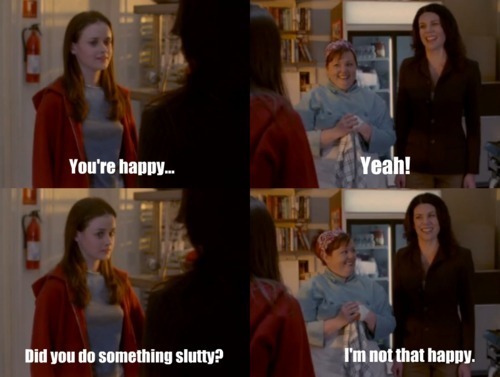
3. It's hyperbolic. In order to convey characters in sometimes as little as two or three minutes, writers resort to extremes. In the opening scenes of the Gilmore Girls, we see Lane skanking to Rancid and discussing her religious mother and her Korean heritage. We see Lorelai make a joke about being *ahem* promiscuous, and we see Lorelai and Rory bond in a not-normal-mother-daughter way. The chances of that all happening on the same morning? Hmmmm. Slim. Very slim. But it carves out who these characters are right away. 

When writing, you can do this, too. This is the infamous show-don't-tell at work. Don't tell us Lane is being raised by strict Korean parents who disapprove of her rock star ambitions: Show her avoiding those parents and gravitating toward the rock n roll. 

4. It's a veritable what-not-to-do. There's a lot of bad TV out there. A LOT. And by watching just some of it, and watching critically, you can see what not to do. You can find flimsy plots, poor character development, tropes, cliches, and just plain bad storytelling all over the place. 

The trick is to identify why it's bad and then comb your own writing for those errors and eliminate them. 

5. It's a more interesting version of school. True story: I know an author that needed to learn how societies fall and flourish for her fantasy world-building. She watched the Guns, Germs, and Steel documentary. It took her three hours. I read the book. It took me five weeks. 

Another friend said she learned a lot of terminology from a crime show (she then researched that terminology to make sure she used it right, but she wouldn't have even known where to begin if not for CSI reruns). 

Documentaries or shows dealing with real-life situations can help you get a feel for a subject you're unfamiliar with. Of course, you'll need to do more research if the show you're watching is dramatized, but television can give you a foundation and a passion for something you might otherwise not have known about. 

6. It's full of real people talking. If you've ever had a beta reader or CP say your dialog sounds unrealistic (and based on my experiences as a CP and beta reader, I'm going to guess that 90% of you have), you need to watch more people talk. Television is really good for this. 

It's even better than real people. 

Yes. It is. And here's why: real people have to think about what they're saying as they say it (ideally, they think about what they're saying before they say it, but let's not get carried away). TV people have the perfect thing already ready. There are no verbal pauses, there are no words being used incorrectly. It's perfect dialog. 

7. It's full of real people moving around and expressing themselves. You need help writing gestures people make while they talk? Or the way a fight moves around a room? Or how people's hands move on each others faces and bodies while they kiss?
TV will give you all of that. Pause. Rewind. Watch again. And again. (try getting the people at the mall to do that for you - it won't go well) 

8. It's visual inspiration. As my good friend Suz said, "One zombie scene is worth thousands of words." 

For those of you who pin visual pinspiration, or who scour modeling sites to find the right face to inspire your love interest or main character, try surfing the television. It's easier to get a feel for how these scenes and people can inspire you when you see them moving and living and being. 

9. It's easier to see what's happening. Television shows can successfully juggle dozens of viewpoints and storylines without losing the viewer (hello, soap operas!). Books often struggle with this (with the exception of the ineffable George RR Martin, of course). Watching an ultra-complex storyline full of dozens of intricate players can help you weave a more complex tale yourself. 

Even if operatic stories aren't your thing, seeing these complex stories woven together can help you understand literary devices like foreshadowing and red herrings and metaphors. Seeing them come to life is often easier than reading them. 

True story: while watching Monsters University, my seven-year-old noticed a very poignant piece of symbolism regarding Mike Wazowski stepping across lines. That would not be possible in a book: But he now has a grasp on metaphors and symbolic gestures in a way he could not have done otherwise. 

10. It's full of  hooks and cliff-hangers (and curb-hangers). A television show has approximately four minutes to catch and hold your attention before the first commercial break. And then they have to lure you back after a two-and-a-half minute break. Considering most sitcoms are only twenty-one or twenty-two minutes of actual showtime, that's a big deal. You're gone for one-tenth of their storytelling time. 

And yet they get you to come back. 

How? 

Curb-hangers. Smaller than cliff-hangers, but they leave a question in the back of your mind, something that makes you want to return to see how it is resolved. Then these same shows go away for a minimum of a week, but often as long as four or five months, expecting you to return. 

How?

Cliff-hangers. Television has perfected the cliffhanger. Indeed it was a silent-film serial that gave us the term, and we see it used so often that people expect them. So much so that I've seen a non-cliffhanger-season finale and thought, "WHAT? That's IT? We don't get a big cliff-hanger???" 

If you need help figuring out how to build to a climax and leave it unresolved, watch television. It will teach you. 

11. It's a mental palette-cleanser.  This might be the most important reason of all. Television tells a story in a very brief amount of time - usually a complete conflict and resolution in just over twenty minutes. Some picture books take longer to read than that. You can watch something quickly, or watch a lot of somethings in a row, and get a much-needed break from your writing. 

My favorite shows to watch for storytelling elements are How I Met Your Mother, Gilmore Girls, and The Office. Others have recommended: LOST, Walking Dead, The Vampire Diaries, and Buffy.

What shows do you watch to learn about storytelling? What shows do you just like to watch? What storytelling tips and tricks have you gained from television? 

Tuesday, November 19, 2013

4 Ways to Write Faster Than Ever

Whether or not you do NaNoWriMo (and by this point in November you've already decided if you're going to finish or not), if you want to make a career out of writing, you will absolutely need to know how to draft quickly.

As a writer, unless you are one of the rare handful of uber-successful multi-millionaire writers, you will constantly be working on someone else's schedule. Many of us spend years writing our first book, churning out the first draft slowly over many, many months. But if and when you sign a contract, you don't have the luxury of moving that slowly for the second book. Agents and editors will want to see early drafts very quickly, often as quick as sixty or ninety days. And that has to be a draft that you're comfortable presenting to them. Not your first draft.

Experienced, multi-published authors get in the habit of getting the story down, drafting entire novels in a month or less (Robison Wells famously drafts each of his novels in two weeks or less - VARIANT was drafted in eleven days!)

If you're someone (like me) who spent much longer than that on their first draft, you might ask "HOW DO THEY DO IT?!?!?"

I have the answers for you. Buckle up. This is going to go quickly. (Not really)

- Plan before you write. 
Put together an outline, or a plot, or a rambling summary. Make character biographies, create a list of names that fit in your world that you can draw on quickly, have an idea of terrible things that could happen to your character. You might not use it all, but having a mad-libs sort of list to fall back on is a lot better than spending an hour "researching" all the ways teenaged girls can hurt each others feelings.

And by "research" - I mean watching 90s teen movies. Obviously.

- Utilize the placeholder. 
When I get to a place where I can't think of the word, or I realize I haven't built that piece of the world yet, I put "XXX" in the manuscript and move on. At last count, my NaNoWriMo project has about 41K words, and 31 instances of XXX. The XXX stands in place of towns, directions, people's names, list of ingredients, description of weapons, symptoms of an illness, anything that I need to do more research on or need to think about.

The XXX allows me to keep writing. I know where the scene or the conversation needs to go, and I don't want to get bogged down by details and research right now. I'll come back to it. When I'm done drafting (or if I have a few minutes to spare and need a mental break), I'll use the search function and find all the XXXs and replace them, one at a time.

- "Insert this kind of scene here"
When I know I need to have a transition scene, or a scene where someone reveals some information, but I can't get the words to flow, I type, in big capital letters, "INSERT A SCENE WHERE SHE CONFESSES HER LOVE BUT HE REJECTS HER". Then I move on to the scene I am mentally/emotionally prepared to write. It's not always that specific. Sometimes it's "INSERT TRAVEL SCENES HERE" or "INSERT SOMETHING AWFUL HERE".

Then I use that handy-dandy search function to search for the word INSERT and take care of each scene, one at a time.

- Make changes inline. 
Sometimes I'll realize I need to foreshadow something, or that I've written a bunch of scenes out of order. In line with the text, I'll type in "XXX move this scene up - before she eats breakfast" or "XXX add stuff about his hair before this". This way, I don't waste valuable drafting time scrolling up, searching for just the right paragraph, and finding ways to do these little things.

So that's it. Those are my tips.

What are you fast-drafting tips?

Tuesday, October 22, 2013

Plotting for Pantsers

I'm gearing up for NaNoWriMo which I will TOTALLY finish this year.

(this is your cue to roll your eyes and say "yeah right" because I've failed for three consecutive years)

(no, like, I've really failed - logged less than 15,000 each year)

But this year? This year I am going to WIN.

In preparation, I've been plotting and pre-writing and doing all the things that I have dutifully stayed away from as a dedicated, artistic pantser. I love to see where the story takes me and follow my muse. But, since it took me well over a year to write my last novel, I'm coming to the conclusion that maybe pantsing isn't the most efficient way to go about writing.

So I'm learning about plotting.

And it's hard.

But I've rounded up some of my favorite resources on the topic, so maybe you can do some plotting, too. Because NaNo is only *checks calendar* eleven days away. *checks calendar again* That can't be right.

The Snowflake Method - While the illustrious Jordan McCollum didn't invent this method, she wrote the best, most clear post on the subject. Basically you start with a basic (like, one sentence) summary of your book. Then you elaborate on that sentence until you have a paragraph. Then you elaborate on the setting. Then the characters. And so on and so on until you have a robust outline.

The name comes from the idea of a fractal. I know, math, ugh. But stay with me. If you take a basic shape, like a triangle, then you add a triangle to each side, you make it a slightly more complex shape, right? Then you do that again, and you have a snowflake. Something simple, when you elaborate on each piece of it, becomes something much more complex and robust.
I'm a novelist, not a cartoonist. I use words not shapes, but you get the idea, right?
The Three Act Structure - This is a really common method of outlining, but to see it broken down in video form was really helpful for me. The vlogger actually goes further and breaks each of the three acts into three more acts (nine acts now) and then three more acts, to create a twenty-seven act structure. Each of those acts stands as a chapter in her first draft.

The Seven Point Structure - So far as I can tell, this one is attributed to Dan Wells, but I could definitely be wrong. Here, you work with a hook, a midpoint, a finale, two plot turns (one is the catalyst) and two pinch points to create a basic framework for your story. You can layer multiple seven-point plots in your story; Wells' powerpoint on the subject uses The Matrix as an example and shows the seven plot points for the main plot, the romantic plot, the betrayal plot, and the personal character plot. The seven points are different for each individual story, and layering them together is a simple way to create subplots for a more complex story.

This is my favorite plotting method, though I do combine it with the three act structure (not the twenty-seven act structure, just the first three) to make my outline feel ultra-super structured.

What? If you put a structure inside a structure it's, like, ultra-structured, right?

Also, since I write speculative fiction, I highly recommend the Worldbuilding tag on Writing Excuses. Writing Excuses is an excellent podcast, full of tips and techniques for just about every part of novel-writing. They have dozens of podcasts on worldbuilding (if you count the ones that are also tagged "world building" instead of "worldbuilding" ... I dunno) that help you think about the "little" things in your world. This is excellent to do in the pre-writing stage, so that when the time comes to actually write all the words, you don't have to stop and think about what your character would eat, or whether or not a woman in that culture would behave that way, or what kind of trees populate the area.

And that's what NaNoWriMo prep is all about: Getting the world built and the novel planned and the characters named so that when the time comes, you can just write, write, write, write.

If you want to look me up on NaNoWriMo.org, my name is Ginadenny. I save my creative juices for actual writing, not drawing snowflakes or thinking up screen names.

Tuesday, September 10, 2013

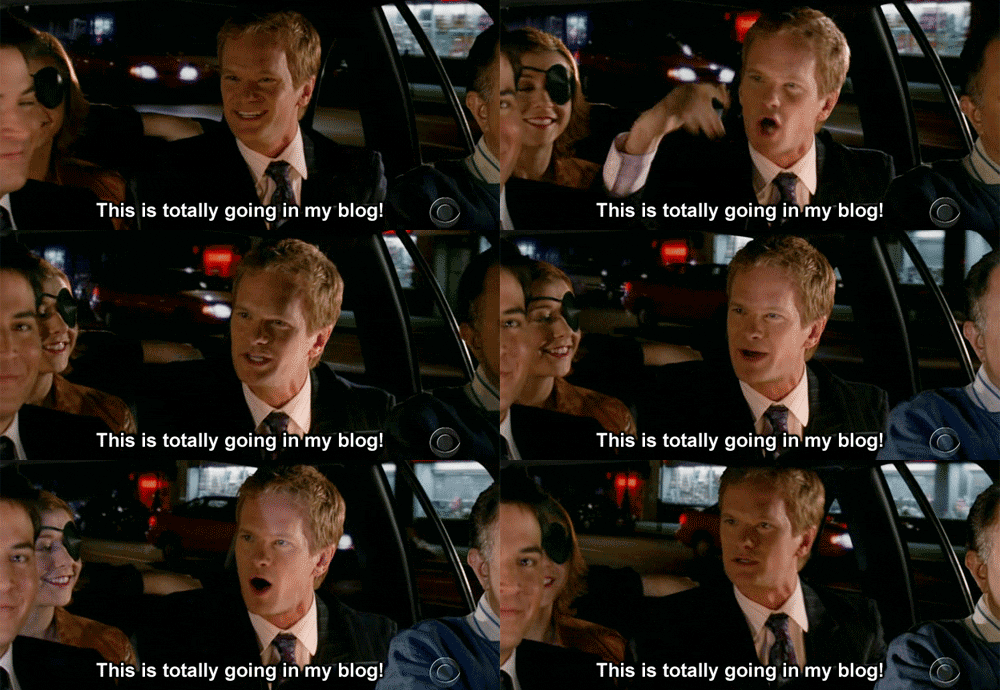
Storytelling Tips from HIMYM

I love the show, "How I Met Your Mother" for a lot of reasons. I love that it doesn't paint marriage as a death sentence, I love that they balance reality with ridiculousness, and I love that they plant a dozen Easter eggs every season.

But most of all I love they way they tell a story. Not just the big, overarching story of how he met his wife (which we are just barely getting to, eight seasons in), but the little stories, the ones encapsulated in a season, or a few episodes, or sometimes in a single episode. I've been watching the entire show, from the beginning, and I've collected some storytelling tips. 

Don't start at the beginning. Some of the best episodes start at the end. One episode starts at the end, showing a disastrous end to a party. Then the story jumps back five minutes and tells what happened in the living room to lead to disaster. Then it jumps back and tells what happened in the dining room, then the kitchen. They could have told us, start to finish, what happened, but it would have taken five minutes and been much less interesting. 

Another episode shows the entire gang at brunch, smiling for a photo. As soon as the camera snaps, they all snarl about how they hate each other. Ted then goes back several days, and explains each person's problem, leading up to the brunch and explaining a lot of character stuff along the way. It it much more interesting to see how Marshall's calves are part of the story or why Ted is mad at his father after seeing how it had an effect on everybody. 


Skip over the stuff that sucks. Several times, Ted tells the audience something along the lines of: "nothing interesting happened all summer... let's skip ahead to the autumn of breakups." If it's not interesting, skip it. I don't care if it makes you feel good to tell us how blissfully happy your main character was before she found out her boyfriend cheated on her. It doesn't matter. Skip the stuff that sucks and get to the stuff that's entertaining. 

Some details aren't important. Ted is telling a story that's about twenty years old (he's narrating from the future), so some details are forgotten. People's names, what order things happened in, what day the goat was really in the apartment, etc. Some of it just isn't important. In the show, they fill in the gaps in a comedic way - her name was Blah Blah, for instance. But in our stories? We can just skip them. 


Give your characters genuine flaws. Lily is manipulative. Marshall is childish. Robin is selfish. Ted is kind of a pompous jerk. Barney is cold, callous, and manipulative. And yet you root for every one of them. Those flaws, though real and truly terrible, are also wrapped up in a package that we can identify with. Who hasn't wanted to step in and stop their friends from making mistakes? Who hasn't wished they could slap somebody for being stupid? Or wished that they could put themselves first? Or that they were able to recite stuff in Italian? Or... no. I've got nothing for Barney. But aside from his flaws, he's a loyal and generous man, and he changes his tune by the time we start really rooting for him. 

Tie it all to the main conflict. The show is about how Ted met his wife. Obviously, eight seasons in, we've talked about other stuff along the way. But just when you start thinking, "What does this have to do with him meeting his wife?" it all gets tied together. We learn about the yellow umbrella. Or the roommate. Or the rock band. We see how this string of events pushed Ted into doing something he wouldn't have done otherwise, and it put him on his path to meeting his future wife. It might be related tangentially, but it's all related to the main story. 


Be consistent. The producers of this show are obviously obsessive about continuity. The show does an incredible number of flashbacks and flashforwards and flash-to-this-is-how-it-could-have-gone-but-didn'ts. And they remain thoroughly consistent. Little things that don't really matter to the scope of the show (Lily's hair color, Barney's tie, Ted's sneakers) are all consistent. If Lily had bangs two years ago, and we're flashing back to two years ago, Lily will have bangs. Which means the girls end up wearing a lot of wigs and the wardrobe department must be a nightmare ("We need a designer dress from six seasons ago, in a petite size!" ... yikes) But it serves the story, and I salute them for it. 

Make your character do something stupid. In the very first episode, we learn that Robin is not going to be Ted's wife. Yet he tries to make it work with her. Repeatedly. And every single time, I feel like I'm yelling at Anakin Skywalker to just choose a different path. We know how it's going to end. But it's entertaining. And it's realistic. So Ted keeps trying, and we keep shaking our heads. I've said it before and I'll say it again: Good fiction is made of bad decisions. 


Give your character a rich backstory, but don't talk about it until it matters. Robin was a pop star, Ted doesn't know how to talk about his feelings, Marshall was the youngest and smallest brother, Lily struggles to connect with her father, Barney doesn't know who his dad is. These things all matter, they drive our characters, but they aren't touched on in the first episode. Or even the first season. The details of their past aren't brought to light until they matter - but once they're there, they are consistent with who the character is. 

Motivations are important. Ted wants to get married. Marshall wants to be an environmental lawyer and save the planet. Lily wants to be an artist. Barney wants to get chicks (his words). Robin wants to be a journalist. All their decisions point them in the direction of their goals. Always. Well...


And motivations sometimes change. Sometimes Marshall just needs a good paycheck, so the environmental stuff gets put on hold. Robin questions her independence. Barney falls in love and wants to be treated with respect. And Ted... Ted loses faith. He loses himself. But despite the changes, the characters still make decisions with an eye toward the ultimate goal. He dates girls who are obviously not "The One" but they are necessary to his growth and development. The story is always written with the end in mind. 

What else, friends? Any other great story telling tips from How I Met Your Mother? I'm sure there are more... 

Tuesday, August 27, 2013

Carlie Webber's 60 Queries and What We Learn From Them

During Write On Con, agent Carlie Webber wrote a "60 Queries in 60 Minutes" post to give us all a little peek into her slushpile. It's a wonderful opportunity to see why queries get rejected, and it was an extremely informative post.

I'll let you go peruse the list, if you'd like, but I've crunched some numbers here that might brighten your day (or make you cry... but let's pretend it's the first thing, yes?)

First of all, I need to point out that she actually shared sixty-two queries with us. Her numbering got fumbled in the middle and we got bonus insight. SCORE. Of those sixty-two queries, only nine made it to the Sample Pages round.

Nine.

That's around 14% of her slushpile made it to sample pages. That's not the people who get upgraded to a partial or full or even get an offer of representation. That's who made it past her inbox. Okay. So let's think on that and be intimidated for a moment...

Now on to the better news. Of those fifty-three who got form rejections right off the bat, eight were rejected for not following the most basic rules. They didn't submit a query letter because they "didn't feel like writing one," or they queried an entire series at once, stuff like that. That means about 13% of her inbox that day was people flat-out not following the rules of querying.

Another twenty-three (37%!) didn't do their research. And remember, this is just a query, not the actual novel. So we aren't talking about actual research, we're talking about easy research. Stuff like word counts (YA fantasy at 212K?!?), what publishers are looking for, what agents are looking for, or even how to write a query. Learn how to write a query letter. It's important. As important as writing your novel.

Don't let yourself be the person who writes a killer novel but then gets rejected because you didn't realize you shouldn't have rhetorical questions in your query letter. 

Lastly, and most heartbreakingly of all, are those who were rejected though there was nothing overtly "wrong" with their query. Twenty-two queries, or 36%, were sent form rejections for being "not compelling enough" or having "not enough spark." Lack of connection, lack of focus, lack of an obvious plot in the query. All these things were things that the author just probably has no idea they are doing wrong. On the upside, almost half of these were things that Carlie said would more than likely appeal to other agents and editors and she felt bad about rejecting them.

So here's what we learn from all this:

- You can make your chances better by following the rules. Yes. You. You must follow the rules. All of them.

- No seriously. Follow the rules. A full HALF of queries were rejected for not following the rules.

- Make your characters compelling. And your story. And your setting. And when you're done with that, make sure those compelling characters and storylines and settings shine through in your query.

- Sometimes, there's nothing wrong with you or your work. It just isn't a good fit. Keep working. You'll get there.

And that's what I learned from Carlie Webber's "602 Queries in 60 Minutes." What do you think? What did you take away from this post?

Thursday, January 17, 2013

Brandon Sanderson Teaches Writing

It's January.  We're full of warm memories from the holidays, or perhaps finally triumphing over the latest bout of whatever flu bug is making its rounds.  Time to pull out the old manuscripts, dust em off and dig in, right?

Feeling a little rusty?  Sometimes it helps to have some motivation.  What better than free online writing classes (in the form of YouTube videos) from master author Brandon Sanderson?


An author by the name of John Waverly has composed a playlist of the lecture series, and you can link to it here.

Happy writing!

Saturday, September 15, 2012

Saturday So What: 1st Person POV Pitfalls

So for this week I have been cleaning up and tweaking my YA Fractured Oz fairy tale, House of Emerald. An agent requested a full manuscript, so I wanted to make sure it's my best. But one of my beta readers noticed I had fallen into the 1st person trap. Now I have to go back through and dig myself out of it.

One of the reasons that YA and mass market adult fiction has turned to 1st person POV writing (telling the story from the I point of view) is the ability to really get into your character's head. But there is such a problem of too much of a good thing. If you live in your head most of the time, the story can be slow. Or have difficulty progressing. Thoughts and feelings are great, but sometimes we rely on them to fill the book and nothing is there to push the action forward except thought. I thought today might be a good day to go to the market. It is much stronger if some outside force pushed your character along. Like her mom asking her to go. If your characters thoughts read as half of your written material, you're in trouble.

That leads me to another pitfall. It is closely tied to the above problem, and is often a cause. One is the loneliest number. If your character has no one to react to, to bounce off of, they have nowhere else to go but in their own head. You need sidekicks, or a lot of action happening to your character. If your MC is in their room lamenting, it won't be all that interesting.

The next pitfall is tricky. It's really tough to get around and one that many new writer's fall into. The narcissist. Since your writing all from one person's point of view, it's easy to structure a lot of your sentences with I verb ___. I felt sorry for her so I took her a loaf of bread. If you have a lot of I sentences in a row, it get super obnoxious. Try changing up the structure. Feeling sorry for her, I took her a loaf of bread.

The last pitfall to avoid is being likable. If we are spending a good amount of time with you MC and in their head, they can't drive us nuts. There needs to be character growth, but if you MC is whiny we may want to shut the book on her. They don't have to be good, just not annoying or somebody we can't stand. This is true in any POV, but especially true in 1st person. If you want a good example of an interesting likably unlikable MC, check out Dan Wells, I am not a Serial Killer.

Saturday, July 21, 2012

Saturday So What: Do you have a case of the T.M.I.'s?

 With the advent of social media, sometimes we all suffer from the TMI's (too much information). Does the world really need to know what you had for lunch today? Or how many times your kid went peepee in the potty (guilty).

Setting that aside, as a writer do you suffer from TMI? And I'm not just talking about inappropriate info either. Are your stories overfilled with choreography or mind numbing detail that doesn't provide insight or advance the plot? Do you describe the scenery to the last tea kozy? Describe the meal to the last crumb? Not every action needs to be shown.


 But Betsy, my character has to eat! True, but your character uses the potty too, but we don't usually narrate that.

As writers, I think we fall in love with the world that we have created, and we want everyone else to see it as vividly too.  We can fall into the trap of writing every moment out just as we see it in our heads. From which hand reaches for the salt shaker to the color of the marble flecks in the counter.

 Don't get me wrong, details are good. Especially slightly odd or interesting ones.  Done right, they can give depth and mean more than just the surface words. But too much, and those little pieces of the real meat of the story get lost in the filler. Think the story version of the 99 cent hot dog. Where's the beef?


Until next week, join me on my blogs as I plead for a civil political season (yeah that'll happen), in If you can't say something nice. And see if your eating habits resemble the family dog in Fighting Fido.


Thursday, June 28, 2012

Sometimes You Have To Be Cruel To Be Kind

...and I'm not just talking about critiques.

One of my critique 'besties' was giving me advice about my writing the other day.  She pointed out that the main character in my story was too protected.  That he was living in a bubble.  I realized immediately that she was right, and as I contemplated on the point, I began to see a pattern that extends back through all my work.

I take my protagonists and I wrap them in comforters, seal them in bubble wrap, and then tuck them carefully into a cushinoed box, before placing it on a high shelf.  They watch their story unfurl, but from a safe distance.

You see I like them, and I don't want them to get hurt.

The problem is, as the author, it's our job to dangle them over steep foreboding precipices by the tips of their bleeding fingers.  Our readers expect us to bring them as close to the edge of ruin and danger as we possibly can, without suspending belief.

Because then they can bring themselves back.  Because then the reader cares about our protagonists as much as we do.  Because then we have a story to tell.

What my friend pointed out was not new information.  It's not a radical idea, and yet I had never applied the notion to my own writing.

Now I understand - sometimes you have to be cruel to be kind.

Anybody have a pin?  I have some bubbles to go pop...

Friday, June 1, 2012

The More I Learn

The better I will be (hopefully). :)

My primary focus lately has been on editing. The learning curve got so steep I almost fell off. Seriously. I put what I thought I knew into The Tyrant King, had test readers and self edited it until I didn't think I could do any more to it. Then an actual editor got their hands on it, and it's a whole new ballgame.

First off, I don't know nearly as much as I thought I did. That one wasn't must of a surprise. It's kind of like all the rules I was following were for mainstream fiction and not so much for fantasy. You actually write fantasy a little different.

I also have a huge problem with repetitive words. Not the same word every time, but sections of the story where I use a word over and over. Not too easy to do a whole MS search for those when they vary with each section. (no lie, I also had a lot of repetitive words throughout the MS that I could search and replace) And the word "said." I was told it was pretty much an invisible word, but, apparently, you can use invisible words too many times.

I'm not saying any of this to freak you out. And you can't really use my editing experiences to take apart your MS. All writers are unique. I'm only using these examples to illustrate what I don't know.

Most of you are aware I have a traditionally published novel. The problem there is that I learned almost nothing through their editing process. (which is actually something else I suspected) I also think that contributed to the fact that they didn't accept the sequel. Looking at my MS from an outside POV I'd have to say I probably would have thought it had too many problems to publish.

Editing is golden. Even though the learning curve is steep, I'm really getting a lot out of it. Not that any of this is easy. It's hard to feel like you've got the best thing you can do only to have someone pick it apart and tell you everything that's wrong with it. What I am learning, though, is that what I thought was my best wasn't. Yet.

Now if only I could work out my comma handicap...

Friday, May 25, 2012

Punching the Clock

As most of you know, for months now I've struggled with some personal frustrations with my writing progress. Some I've shared here, while others I've posted on my author BLOG. I want to emphasize most of this has been self-inflicted. I've been feeling stagnant, unworthy, and untalented.

I am starting to wise up.

Part of that is due to the encouragement of some really amazing people in my life, but--as I'm sure you know--the only ones who can fix me are me and God. So I've been working on that aspect of my life, too. God's wonderful that way. Patient. Forgiving. Full of encouragement for the future.

Wednesday night we had a family meeting. I explained to the kids my new writing schedule and, more importantly, WHY I had a new writing schedule. And now I'm going to explain it to you.

I have spent a great deal of time calling my writing a career while treating it as a hobby. While I know writing is not a get-rich-quick scheme, I have been too obsessive and consequently frustrated by the lack of revenue. I'm not talking about hundreds of dollars. I'm talking about any dollars. At. All.

As usual, a change in direction required a change of thinking. On my part. I've worked enough jobs to know if you want to get anything out of it, you have to put something INTO it. If I want to make money--even just enough to supplement our family income a tiny bit or be able to afford to continue writing--I have to WORK for it.

I have this quote on my FB wall: Opportunity is missed by most people because it is dressed in overalls and looks like work. ~Thomas Edison

Well, I for one am tired of missing opportunities because I'm too dense to recognize them for what they are.

I also know I'm not the only one who's had an epiphany this week. Share yours. You may end up helping someone else. :)

Friday, April 20, 2012

R is for Reaching

You may be wondering what reaching is, or what type of reaching I'm talking about.

Reaching for the stars?

Reaching our readers?

Reaching for that bit of chocolate? ;)

Actually, I'm thinking about reaching deep within. Ourselves. And using what we know to make our writing the best it can be. LDS author Heather Moore recently did an INTERVIEW where she discussed putting emotion into your writing. And while Heather is, of course, spot on, I just wanted to add a little bit of my own experience and observation.

Writing a story is a relatively simple process. We've been doing it since grammar school. But, writing a story--especially a novel-length story--that keeps your readers hooked, invested, and interested from chapter to chapter can be daunting. But, I submit, it's something ALL of us can do. We are writers. This is what we chose (one could argue it chose us). We CAN do this.

Each of us has experienced intense emotion in our own lives, even though our lives are different and these emotions were brought about by different happenings. But if I asked you to recall a time when you were absolutely devastated, I bet you could. Or a time when you were so happy words failed you. Or a time--even from childhood--where you can remember being so scared it defied logic.

 Your characters don't have to have the same experiences you did to bring about this or that emotion, but you can reach within and bring out that particular feeling that can then be conveyed to your reader through your words. We can be powerful writers. No, we won't affect every reader the same way, but if you lace your writing with powerful emotion, you will bring about a response. I'm not going to say that's always easy. Currently, one of my works in progress involves reliving some really difficult feelings from my past, things that I have long put behind me. Odd how they're still there to be called up as needed, though.

Remember, There's nothing to writing. All you do is sit down at a typewriter and open a vein. ~Walter Wellesley "Red" Smith

Thursday, March 29, 2012

The "Why" of Critiques


If you've spent enough time hopping around blogs or how-to books on writing, you've probably heard this sage advice to improve your writing skills: Get regular, peer feedback. It's almost as important to the health of your manuscript as regular dental check-ups are to the health of your smile.


Why? No matter how many hours you spend staring at the text on the computer, you will never catch all of your mistakes. Even when you know your manuscript upside down, inside out and backwards in Latin, little but glaringly obvious errors will slip by. Feedback gives you a fresh pair of eyes that aren't married to your story. It makes a difference. Even software spellcheckers can't find every problem.

Also, as a writer, criticism comes with the territory. If you walk around barefoot all summer, by the end of the season the task becomes easier - little pebbles and twigs are less of a nuisance, because you've toughened the skin on the soles of your feet. Getting honest (and hopefully positive) feedback now will toughen your writer's skin for the day when the harsher words start flying (and they will occasionally).

And, writing is a solitary hobby. Critique groups and critique partners are another form of networking that creates connections with other's who get you. The crazy writer side of you, the one at which your husband and children raise an eyebrow in deep concern...

...like when you start having arguments with your MC who just won't do what you tell him to....Aaaggghh!

And there's other reasons too - please share your thoughts and leave a comment!

P.S. Tune in next week for part II of this topic....

Friday, March 9, 2012

Progress Report

First of all, a HUGE THANK YOU to everyone who commented on last week's post about my title troubles. I really think you helped me head in the right direction and I wish I could give you all a prize. But my thanks will have to be enough.

I hit another block with Ruby's story, and it's something I really have to search deep inside myself to resolve. Initially, I really wanted to set the book in Duncan, OK because I have fond memories of the place and wanted to show a different side of what is sometimes considered a backwater area. My idea, since I'm telling the story from Ruby's point of view, is to show how annoying she finds everyone and everything about her new life at first, but how eventually even the acts of strangers begin to warm her heart.

But now I'm kind of hit with a crippling fear that locals reading the book will be so disgusted by the stereotyping and cliche characters at first they won't wait around to see how it gets better. Because, right now, the only characters who come to mind are cliche and stereotypical.

That's my current problem. I'm the first to admit that being a Mormon in the middle of the "Bible Belt" is difficult. One of my sons has already been told by a classmate he's "going to Hell" because he's LDS. We have lots of religious discussion in my house now, more than we did when living in UT, and most of it is started by our kids. I think it's because they feel the lack of what they used to know, and seek their grounding in the gospel because it is familiar and true. And, not to point any blame, but the current political atmosphere is NOT making things easier on my kids. Weird, huh?

Last Sunday, author Rachel Ann Nunes posted on FB about a bad review her book received on Amazon--not because the reviewer didn't like the book but because the reviewer felt there should be a distinction between LDS fiction and Christian fiction. Again with that whole "Mormons aren't Christian" nonsense. As a lifetime insider, I confess I don't understand how people can say we aren't Christian. It's in our name. And I pity the poor soul who ever tells my daughter she's not a follwer of Christ. That girl, who can greet Jesus like an old friend, will happily correct them.

I don't want you to come away thinking everyone out here is against us, because that's not the case. Before we moved, each of the kids received Father's blessings. The predominant theme was that the people out here are also God's children, and they are good people with good hearts, and that we don't need to shut them out in order to maintain our faith. In fact, more kids asked my son "What's a Mormon?" than condemned him to Hell for being one.

Religion aside, I'm still struggling with this fiction novel of mine. It will be obvious to any LDS reader of Ruby's story that her aunt's family is LDS. But I want to emphasize the Christian aspect of their beliefs and actions, so that anyone else reading the book won't immediately shut down because it's about a bunch of Mormons. This isn't for some future big reveal, but more for myself. I want the story to resonate with all Christians. Which is why I'm self publishing it and not going through an LDS publisher or trying to hit up a national publisher (because they'll make me take out the religious aspects and mess up my whole plan).

I think I've been more rambly here than I intended. And probably what I'm going to have to do is delve into these supporting characters in Ruby's story and find out the parts of them that make them loveable and less like the cliche, stereotypical book fodder they currently are.

Friday, October 7, 2011

Highs and Lows

I've been slowly but surely working my way through my manuscript for The Tyrant King, trying to make it the best I possibly can. Recently, kind of on a whim because I didn't expect to enter anything, I entered the first chapter in a contest that's part of the writing retreat I'm attending in November. This week, we found out the contest results.

As I read through the blog announcing the first, second and third place winners, I consoled myself with the thought that I hadn't expected to enter, and really hadn't expected to place either. I thought, if I'm going to enter the contest, I want to take a little more time on the chapter, tighten it up and make it "perfect" before I send it in. But, when the deadline came, I couldn't make time to work on it so I just sent in what I had. After all, it's what I submitted to the publisher in the spring--with a few minor changes since then.

Then I got an email detailing my placement in the contest and containing the judges' evaluations of my work.

I placed 5th.

I'm probably disproportionally proud of that achievement. But, to be honest, I'm ecstatic to have placed 5th. That's only two away from being a prize-winning piece. It's pretty cool for me--as long as there were more than 5 entries...:)

But, seriously, the best part is the judges' feedback. I love when I get input that helps me grow as a writer and makes my work stronger and better. I'm really hoping, even though it's going to take a couple extra weeks, when I do send in The Tyrant King for the final time my editor will be impressed by my improvements and the work I've put into it since she requested the changes.

This is a lesson for me. I've never done well with contests, and I decided a while back that I just don't have **award winning** writing, so why subject myself to the roller coaster of emotion that follows entering and then losing a contest? But there is something to be gained through this process. You can get invaluable feedback from people put in positions to judge those contests. Some are editors, some are literary agents, some are more seasoned writers than you are. Than I am.

When I enter a contest again, it's not going to be with an eye on the prize. It's going to be for the satisfaction of learning and growing into the best writer I can be.

Friday, September 23, 2011

A Place for Everything

I'm sitting in the dark on a Thursday morning staring at my computer screen. Why? I really love the dark. I know there's much to be embraced in the light, but I have extremely sensitive eyes and I prefer the dark. It drives my husband crazy, since he feels if there isn't a light on in the house at night he'll stumble into something and hurt himself--whereas I love finding my way in the dark. We compromise and leave a light on. :) (when he's here, that is)

My new living room in HUGE. I'd say you could take four of my old living rooms and put them in this new one. Seriously. I love it. The best of both worlds would be having this size living room when I lived in Ut and was hosting writers' meetings every month. There would be no lack of space to sit. Ah, well.

As things are, I've designated part of the room for my office and part of the room for the living room itself. A whole other section is where I plan to put three large bookcases, maybe even four, for all my books and future books. Not the ones I'm writing, but the ones I plan to read. Initially I was going to section off part of my large dining room (yes, I have one of those, too, now) into a library, but I've chosen to make that my sewing area instead.

Putting together a house is like organizing a story. No, really. As I go through The Tyrant King for the last time before sending it out to beta readers, I've come across things I missed including originally. Finding the right place to put these particular tidbits can be challenging. Some things can't come too early in the story; other things would be out of place too late in the story. These little scenes are lead-ins to other events, so I can't very well put them in after the event, can I?

I'm only in chapter 7 right now, but I am saving some things specifically for chapter 12. I've known for months now I need to rework that entire chapter. It's mostly a telling of things happening, rather than a showing. It's vitally important to me to fix that, even though it was not one of the suggestions my editor had made. I probably won't get there till next week, but if I work really hard I could be done before the end of the month.

It's important to get aspects of your story in the right order, or it may not make sense to the reader. You want your story to be smooth (something I'm still working on) and flow from one thing to the next without the reader pulling back and going, "what? where did that come from?" It's also important, in a series at least, to draw from the previous book enough to tie it in without relying on it, and to give clues to the rest of the story that will come in later books. It's critical you don't leave out a key aspect from the first book in the second book. Yeah, I did that, too.

Here's hoping we can all find a place for everything.

Friday, August 12, 2011

What Bad Hair Teaches You

by Cheri Chesley
(this is not a recent picture--her hair is much longer now)
Last weekend, I spent over $30 on hair repair items for my daughter. She spent an extra couple of weeks in OK with her Papa, and swam almost every day--and ran out of conditioner and didn't tell him she needed more. So she spent most of that time without conditioning her hair.

It came back the texture of straw. Seriously.

Because she's been working so hard to grow her hair out, I opted for helping her fix her hair rather than going and getting it cut short. Although, you have to admit, she looks pretty darn good in an A-line. See?

As I spend day after day obsessing over when to give her the next conditioning treatment, having her wash and condition her hair with products I don't usually buy for myself, I'm reminded of the editing process. I know--I'm such a WRITER! lol

See, many of us--and I'm one of them--want to go through our manuscript 2 or 3 times before pronouncing it perfect! Done! As good as we can make it! But, like these conditioning treatments my daughter and I are doing, it can take a dozen or more work-throughs before we're really done with a project.

I'm slowly learning this. I submitted my sequel to Cedar Fort, happy that it was as good as I can make it, until I heard back from them with suggestions that I make some changes and resubmit before they'll consider offering me a contract. See, they knew it wasn't up to par. And, looking back, I know it too--now. :) After letting the project sit for a month, I realized many holes I'd missed and lots of ways to make the story deeper, more compelling and overall more interesting. I'd gotten the bare bones of the story down, but I needed to embellish.

That has to wait until the summer is over. And, now, after we move.

I want to be a better writer than I am. This will take patience. Like my daughter's hair will also take patience, time and effort to get it back to a semblance of normal. I'm still learning; I'll probably always be learning. But that isn't really a bad thing.

LinkWithin

Related Posts with Thumbnails